


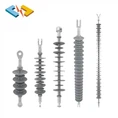

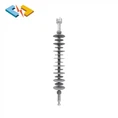

With the rapid development of China's high-voltage power grid, composite insulators with small size, good elasticity, easy to damage, light weight and high mechanical strength have been widely used in transmission lines for their excellent anti-pollution flasmodic characteristics, lightness, convenient installation and maintenance. Composite insulators, as shown in Figure 1, are composed of composite umbrella skirt, steel foot bolt, arc ball, shield and other parts [1]. However, according to different line voltage levels, different geographical environments and differences in understanding, there are different ways to install the voltage equalization ring of composite insulators. Compared with traditional porcelain or glass insulators, there is one more accessory during installation -- voltage equalization ring.
1.The function of the pressure sharing ring of composite insulator
As the name implies, the function of the voltage equalization ring is to distribute the voltage evenly across the insulator string. Usually the two ends of the insulator or insulator string are conductor potential and geodetic potential respectively, that is, the phase voltage. Due to the effect of the wire on the ground coupling capacitance and the phase capacitance between the wires, the phase voltage appears uneven distribution on the whole insulator string. The distribution law is as follows: the insulator voltage drop near the wire end is the largest, and the insulator voltage drop far from the wire end gradually decreases. When the insulator is near the cross arm of the tower, the voltage drop rises. As a result, a corona may occur. The principle of voltage equalization ring is that installing a voltage equalization ring on the wire end of an insulator or insulator string is equivalent to installing a parallel capacitor, thus increasing the capacitance of the insulator to the wire and improving the voltage distribution.
The voltage equalizing ring of the composite insulator has functions such as arc induction (discharge flashover occurs between two rings on the line to protect the umbrella skirt from being burned), metal corona prevention, voltage distribution improvement, and field intensity reduction at the end of the mandel. The core of composite insulator is made of organic material, so the uniform pressure ring can reduce the field intensity of the high pressure side core rod and delay the aging of the core rod to some extent.
In actual operation, if the composite insulator is not installed with a voltage equalization ring, it is an indisputable fact that the surface field intensity voltage distribution is extremely uneven , but the installation position and structure of the voltage equalization ring of the composite insulator have a great impact on the improvement of the voltage distribution of the composite insulator. When the voltage equalizing ring is not installed, the field intensity of the composite insulator near the live end is the highest at the connection between the insulator and the metal attachment at the end, and the distributed voltage on the first skirt near the live end is also the highest. If the plane of the homogenizing ring body is at the same height as the connection of the insulator and the metal accessories at the end, the homogenizing ring hardly plays a role of homogenizing pressure.
2. Types of pressure equalization rings
According to different uses, the voltage balancing ring can be divided into lightning arrester voltage balancing ring, lightning protection voltage balancing ring, insulator voltage balancing ring, transformer voltage balancing ring, high voltage test equipment voltage balancing ring, transmission line voltage balancing ring, etc.
According to different materials, the uniform pressure ring can be divided into aluminum uniform pressure ring, stainless steel uniform pressure ring, iron uniform pressure ring, etc.
There are two kinds of shielding ring and shielding ring with similar names.
At present, the homogenized pressure ring used in Chinese high voltage electrical appliances and power systems (substation, high voltage lines and so on) is mainly processed with aluminum alloy. A general requirement is to polish the surface of the homogenized pressure ring to achieve smooth surface without burr.
3. The voltage equalization ring of composite insulator fails
3.1 No pressure balancing ring is installed or the pressure balancing ring is invalid
When the composite insulator is in actual operation, it is not installed with the voltage equalization ring, or the installation error of the voltage equalization ring, the deformation and displacement of the voltage equalization ring are collectively referred to as failure. If the voltage equalization ring fails, in the case of voltage equalization ring failure, the field intensity of the composite insulator near the live end is the highest at the connection between the insulator and the metal attachment at the end, and the distributed voltage on the first skirt near the live end is the highest. The shift of the pressure equalization ring makes the plane where the ring body is located and the connection between the insulator and the metal accessories at the end at the same height, so the pressure equalization ring can hardly play the role of pressure equalization. If the voltage equaling ring fails, the local field strength will be too high, leading to electrocorrosion, and the electric field strength and voltage distribution on the surface of the composite insulator will be very uneven, resulting in thermal expansion of the composite insulator skirt and the occurrence of flashover discharge trip on the insulator surface, thus reducing the safe and stable operation of the power grid.
3.2 The current design of pressure equalization ring
In practice, the pressure equalization ring has upper pressure equalization ring (low pressure side) and lower pressure equalization ring (high pressure side). In order to better distribute the phase voltage and field intensity evenly across the composite insulator skirt, double voltage equalization rings are now installed on each composite insulator of the 220kV transmission line. The upper pressure equalization ring is mostly designed in half, while the lower pressure equalization ring is a ring design. If the installation process of the lower pressure equalization ring is unqualified or the structure of the pressure equalization ring is abnormal, the pressure equalization ring will fail. The design and installation of the voltage equalization ring will not only cause the voltage equalization ring of 220kV composite insulators to lose its due role. In addition, after the lower voltage equalization ring falls off to the wire, the wire vibration caused by the seasonal wind will make the lower voltage equalization ring continue to wear the wire, cause serious local heating, and even burn the wire, leading to the transmission line wire break, resulting in serious wire tripping accident. Therefore, the fall of the lower voltage equalization ring to the wire will not only lead to extremely serious consequences.
3.3 Maintenance method after pressure balancing ring falls off
If the voltage equalization ring falls off to the wire and wears out the wire, it needs to be replaced with a new voltage equalization ring. Different reinforcement methods should be adopted for different worn wires. The composite insulator should be removed from the wire and replaced with a new voltage equalization ring to reset the composite insulator, which not only increases the difficulty and risk of the operation, but also greatly increases the physical requirements of the operators. There are certain security risks.
How to keep the lower voltage equalization ring from falling off to the wire when it falls off? So this paper puts forward two improvement methods.
4. Improve methods
The new design method of pressure equalization ring is adopted, and the lower pressure equalization ring is also designed to be half. When the installation process of the lower pressure equalization ring is unqualified or the structure is abnormal, the fastening screw of the lower pressure equalization ring becomes loose, and the pressure equalization ring will fall off directly to the ground. Will not stay on the wire, will not cause wire failure. And reduce the difficulty of maintenance operations.
The lower voltage sharing ring of the composite insulator can be welded directly to the metal installation site of the composite insulator. This design will better play the role of pressure equalization ring, and the maintenance requirements to a minimum. But this design will increase the requirements of manufacturers, and for the transportation of higher requirements, transportation will occupy a larger volume.
5.Summarize
The voltage sharing ring under the composite insulator of 220kV transmission line adopts the butt structure, which is easy to install and greatly reduces the consumption of manpower, material resources and time.
220 kV composite insulator butt type voltage sharing ring structure is simple, the voltage sharing effect is better than closed structure voltage sharing ring.
The new design and technology and good quality control can ensure that the butt voltage equalization ring can meet the requirements of 220 kV transmission lines.