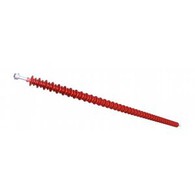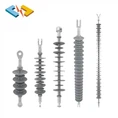

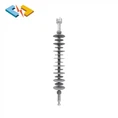

We enhance the market competitiveness of our Composite Insulator Rubber, Tension insulators, 45kV composite polymer pin insulator and increase the economic benefits of our company. Our company adheres to the business philosophy of 'win the market with quality and gain profit by efficiency'. Create attractive products and create a loyal customer base. We've been following that philosophy for years, and that's how we've grown to this size. We strictly implement all enterprise systems and hope to form a culture of honesty and integrity in the company.
110kV 17.2kN Composite Station Post Insulator
Products Description
|
Model |
Rated |
Specified Cantilever Load(SCL) |
Maximum Design Cantilever Load(MDCL) |
Routine Tensile Test Load(RTL) |
Power Frequency Withstand Voltage(Dry/Wet) |
Lightning Impulse Withstand Voltage |
|
(kV) |
(kN) |
(kN) |
(kN) |
(kV) |
≥(kV) |
|
|
FZSW-110/17.2 |
110 |
17.2kN |
7.7kN |
16.5 |
315kV/275kV |
570kV |
Features:
1. Perform excellent anti-pollution capacity and explosion proof.
2. New type insulating materials for inner insulation and high tempreture sulfarated silicone rubber for outer insulation
3. They are consistent with current developing trend of requiring no oil and miniaturization by electricity sector.
knowledge
Post insulators used for busbars or disconnectors are typical examples of station post insulators applied in power plants to provide insulation and a mechanically secured connection between conductors and grounded structures. They are assembled by bonding solid porcelain columns with upper and lower metal fittings using cement adhesive. Because the flashover distance along the outer air path is nearly the same as the internal creepage path, flashover occurs externally, and internal dielectric breakdown of the porcelain-being a non-puncture-type material-does not take place. For higher voltage levels, multiple post insulator units can be connected in series. To enhance mechanical strength, several post insulators may also be installed in parallel when required. These insulators are capable of bearing bending moments and torsional forces.
In recent years, China has developed a composite station post insulator that uses a porcelain core combined with a silicone rubber housing. This design provides better electrical and mechanical performance compared with traditional porcelain station post insulators. Silicone rubber offers higher mechanical strength and improved resistance to pollution flashover, giving the composite type substantial potential for broader application.
A variety of factors-such as electric field strength, mechanical loads, environmental stresses, and climatic conditions-affect the performance of outdoor insulators during operation. These factors act simultaneously, and their influence varies depending on the insulator's type, structure, and installation environment. For example, suspension and tension insulators must bear the tensile load of the conductor as well as their own weight. Additional tensile forces may arise due to strong winds, icing, or temperature variations. Station post insulators, on the other hand, are subjected primarily to compressive forces, along with bending moments and torsional loads.
When evaluating the mechanical forces on station post insulators, both the static load from supported busbars and equipment, as well as electromagnetic forces generated under fault conditions, must be considered. Cantilever-type cross-arm insulators also experience bending moments from conductor loads. Insulators may be exposed to various transient forces, including torsional loads during transmission-line construction and vibration loads caused by conductor swing. In service, they must also withstand impact loads from natural or accidental sources such as storms, earthquakes, or the sudden drop of ice-covered conductors.
Electrically, insulators must tolerate not only steady-state power-frequency voltage but also transient overvoltages caused by lightning or switching operations. All three voltage types must be considered when determining the required insulator string length or dry arcing distance. In general, lightning overvoltage is the primary factor influencing dry arc distance below 330 kV, whereas switching overvoltage becomes dominant above 330 kV. During flashover, several thousand amperes of fault current may flow along the insulator surface in the form of an arc. The insulator must be capable of withstanding the thermal and physical damage of this arc until the protection system isolates the fault.
about us

Over the years of operation, we have established a complete set of production and supply channels, and the price is very competitive in the industry of 110kv Composite Station Post Insulators. Various business resources such as product development, technical capabilities, human resources training, global system, flexible response capabilities, and collaboration with business partners, represented by an independent product manufacturing system, support our company's value creation. We promise to deliver satisfactory products to your hands with the best quality and the fastest speed, and use the best solutions and the most enthusiastic and thoughtful after-sales service to solve the problems during use.
Hot Tags: 110kV 17.2kN Composite Station Post Insulator, China, manufacturers, suppliers, factory, wholesale, for sale, Polymer Station Post Insulators, Polymer Post insulator for electrified railway, 330kV station post insulator, 11kv Post Insulator, Composite Long Rod Insulator, post top insulators