


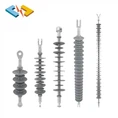

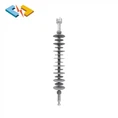


Electrical Post Insulator for Railway
| Model No. | Section Height H (mm) |
Minimum Nominal Creepage Distance L(mm) |
Minimum Nominal Arcing Distance (mm) |
Mechanical Data | Electrical Data | ||
| Specified Mechanical Bending Load (kN) |
Specified Mechanical Tensile Load (kN) |
Dry Power Frequency Withstand Voltage (kV) |
Wet Power Frequency Withstand Voltage(kV) |
||||
| FQBS-25/8 | 850±20 | 1200/145 | 490 | 8 | 80 | 160 | 130 |
| FQBS-25/12 | 850±20 | 1200/145 | 12 | 100 | |||
| FQBS-25/16 | 890±20 | 1200/145 | 16 | 120 | |||
| FQBSJ-25/8 | 850±20 | 1400/145 | 490 | 8 | 80 | 190 | 150 |
| FQBSJ-25/12 | 850±20 | 1400/145 | 12 | 100 | |||
| FQBSJ-25/16 | 890±20 | 1400/145 | 16 | 120 | |||
| FQBSG-25/8 | 890±20 | 1600/145 | 520 | 8 | 80 | 190 | 150 |
| FQBSG-25/12 | 890±20 | 1600/145 | 12 | 100 | |||
| FQBSG-25/16 | 890±20 | 1600/145 | 16 | 120 | |||
Introduction of electrical insulator usage in electrified railway
At present, the silicone insulators widely used in the electrified railway overhead contact network, which have good bending and torsion resistance, excellent mechanical performance, high pollution lightning pressure and excellent electrical performance. Polymer insulator have been widely used in the power supply system of the electrified railway overhead contact network, making great contributions to the safe operation of the railway system and the rapid economic and social development. And we are one of the few factories who could supply hight voltage insulators for 350km/h train.
Performance under Contaminated Conditions: In railway environments, composite insulators are exposed to various contaminants, such as dust, pollution, and salt deposits, which can compromise their performance. Composite insulators are designed to exhibit superior pollution flashover performance, ensuring stable electrical performance even under heavily polluted conditions. The hydrophobic properties of the silicone rubber repel water and contaminants, further enhancing their performance in adverse weather conditions.
Mechanical Strength and Load-Bearing Capacity: Due to the dynamic nature of railway operations, composite insulators must withstand mechanical loads induced by catenary wires, pantographs, and other equipment. They are designed to have high load-bearing capacity, preventing deformation or breakage under heavy mechanical stresses and vibrations. The robust construction of these insulators ensures they can endure the mechanical rigors of frequent pantograph contact and passing trains.
advantages

Our polymer insulator's combination of a premium silicone rubber casing and a top-notch fiberglass core results in superb mechanical and electrical insulation properties. The end product is an extremely dependable and robust insulator that can survive challenging railway conditions.
Silicone Rubber Insulators are resistant to UV deterioration and aging because we employ the finest rubber compositions, which offer great weather resistance. Longer operating life, lower maintenance costs, and greater overall efficiency result from this.
Insulators exhibit unparalleled pollution flashover performance, thanks to the hydrophobic properties of the silicone rubber. This prevents the absorption of contaminants and minimizes the risk of flashovers, ensuring uninterrupted power transmission even in heavily polluted environments.
The hydrophobic characteristics of the silicone rubber give our polymer insulators an unmatched pollution flashover performance. This keeps impurities from absorbing into the system and reduces the chance of flashovers, enabling uninterrupted power transmission even in highly contaminated areas.
knowledge
Electrical Performance: Composite insulators exhibit excellent electrical properties, including high electrical resistivity and low leakage current. These characteristics are vital to prevent power losses and ensure efficient energy transmission along the catenary system. Additionally, low leakage currents minimize the risk of partial discharges and corona effects, which could negatively impact the overall performance of the electrification system.
Comparison with Traditional electrical Insulators: In comparison to traditional porcelain or ceramic insulators, composite insulators offer several advantages for railway electrification. Their lightweight construction makes them easier to handle and install, reducing the physical strain on workers during maintenance activities. Moreover, composite insulators exhibit better pollution performance, making them particularly suitable for areas with high pollution levels.
Hot Tags: Electrical Insulators for Railway, China, manufacturers, suppliers, factory, wholesale, for sale, Composite Suspension insulator for electrified railway, Composite Station Post Insulator, Composite Post Insulators For Railway, Polymer Tension insulator for electrified railway, Polymer Post insulator for electrified railway, Composite Suspension Insulators For Railway


