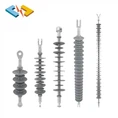


Products Description
Composite station post and line post insulators are an essential component of power transmission and distribution systems. They are made of a fiberglass reinforced polymer (FRP) core and a silicone rubber housing, which gives them several unique advantages over traditional porcelain insulators.
One of the main advantages of composite station post and line post insulators is their superior mechanical strength. They are designed to withstand extreme weather conditions, such as high winds and ice loading, without breaking or cracking. This strength also allows them to be used in longer strings, which can reduce the number of support structures required in a transmission line.
Another advantage of composite station post and line post insulators is their excellent pollution resistance. The silicone rubber housing repels pollutants such as dust and salt deposits, which can accumulate on traditional porcelain insulators and reduce their insulating properties. This pollution resistance makes composite insulators ideal for use in harsh environments, such as coastal areas and industrial zones.
Composite station post and line post insulators also offer several other advantages, including lighter weight, easier handling and installation, and longer service life. They require less maintenance and are less prone to damage from vandalism or accidental impact, which can lead to significant cost savings over the life of a transmission line.
In terms of applications, composite station post and line post insulators are used in a variety of high voltage transmission and distribution systems, including substations and power lines. They are particularly well-suited for use in areas with harsh weather conditions or high pollution levels, as well as for long-distance transmission lines that require fewer support structures.
Composite station post and line post insulators offer several unique advantages over traditional porcelain insulators, including superior mechanical strength, pollution resistance, and longer service life. These advantages make them ideal for use in a variety of high voltage transmission and distribution systems, particularly in harsh environments or for long-distance transmission lines.
Products Parameter
Composite Station Post Insulator
| No. | Description | Rated Voltage (kV) |
Specified Mechanical Bending Load (kN) | Section Height H (mm) |
Minimum Arcing Distance H (mm) |
Minimum Creepage DistanceL (mm) | Lightning Impulse Withstand Voltag≥(kV) | Power Frequency Withstand Voltage≥(kV) |
| 1 | FZSW-66/16 | 66 | 16 | 770±1 | 636 | 1813 | 325 | 130 |
| 2 | FZSW1-110/10 | 110 | 10 | 1220±2.7 | 1084 | 3150 | 450 | 185 |
| 3 | FZSW2-138/10 | 138 | 10 | 1200±2 | 1064 | 3150 | 450 | 185 |
| 4 | FZSW1-110/20 | 110 | 20 | 1220±2.7 | 1044 | 3150 | 450 | 185 |
| 5 | FZSW2-138/20 | 138 | 20 | 1200±2 | 1024 | 3150 | 450 | 185 |
| 6 | FZSW - 252/20 (Upper & lower components) |
252 | 20 | 2300±3.8 | 2007 | 6300 | 950 | 395 |
Composite Pin Type Insulator
| No. | Description | Section Height (H mm) |
Dry Arcing Distance (h mm) |
Creepage Distance(mm) | 1 min Wet Power Withstand Voltage (kV) |
Lightning Impulse Withstand Voltage ≥(kV) |
Specified Bending Load ≥(kN) |
| 1 | FPW1-11T16 | 236±5 | 150 | 390 | 50 | 100 | 2 |
| 2 | FPW4-11T20 | 236±5 | 150 | 390 | 50 | 100 | 3.5 |
| 3 | FPW - 36T20 | 500±5 | 400 | 1200 | 125 | 210 | 12.5 |


Features
· Features
Composite post insulators have several distinctive features. They are lightweight, easy to handle, and offer excellent pollution resistance. They can withstand extreme weather conditions and are resistant to ultraviolet radiation and aging. The silicone rubber housing is hydrophobic, which repels water and reduces the risk of flashovers.
· Advantages
Composite post insulators offer several advantages over traditional porcelain insulators. They have superior mechanical strength, making them suitable for use in longer strings and reducing the need for additional support structures. They are more reliable in harsh environments, require less maintenance, and are less prone to damage from vandalism or accidental impact. They also have a longer service life, leading to significant cost savings over time.
· Application
Composite post insulators are used in various high-voltage transmission and distribution systems, including power substations, railway electrification, and overhead power lines. They are particularly well-suited for use in areas with harsh weather conditions, high pollution levels, and long-distance transmission lines.
Certificates

Standards:
IEC 61109, ISO 9001, ISO 14001, ISO 45001. We can design products in accordance with Client's Requirements.
FAQ abour Wuhan Line Power
1. Q: Are you the factory or trading company?
A: We are factory who was founded in 2008. We also source related items for the client.
2. Q: What're your main products?
A: insulators, the hardware of all kinds for high-voltage applications and related products.
3. Q: Can I get some samples?
A: Yes, sample order is available for quality check and market test.
4. Q: What's your payment terms?
A: We usually accept :Payment Term: 30% T/T after order confirmed, balance 70% before shipment, and L/C is also available.
5. Q: How can you control your quality?
A: For each production processing, we have a complete QC system for the chemical composition, physical and electrical properties. After production, all the goods will be tested according to related standards, and the ex-factory test reports will be sent along with shipment documents.
6. Q: Does your company accept customization?
A: We accept OEM service.
7. Q: What's your warranty terms?
A: We offer 24 months warranty terms.
8. Q: Do you have the products in stock?
A: Depends on your request, we have standard models in stock. Some special product and big order will be newly produced according to your order.
9. Q: What do you have for the certificate?
A: ISO9001, ISO14001, ISO45001, Type test etc.
10. Q: How to become the agents for Line?
A: We welcome you to be Line's agent.
We will depend on the sales turn over and also do research on your market. If you have interest, let us discuss more!
11.Q: Can we visit your company?
A: Yes, for sure, you are welcome to visit our company.
FAQ about composite insulator
1. What is a composite insulator?
A: A composite insulator is an insulator made from a combination of materials such as fiberglass reinforced plastic, silicone rubber, and epoxy resin.
2. What are the types of composite insulators?
A: The types of composite insulators include suspension insulators, post insulators, station post insulators, and line post insulators.
3. What are the differences between composite insulators and traditional insulators?
A: Composite insulators have a higher resistance to leakage current and are less susceptible to breakage than traditional insulators made of porcelain or glass. They are also lighter in weight, easier to install, and have a longer lifespan.
4. What are the advantages of composite insulators?
A: The advantages of composite insulators include high resistance to leakage current, low weight, high mechanical strength, high corrosion resistance, long lifespan, and low maintenance costs.
5. What materials are used to make composite insulators?
A: The materials used to make composite insulators include fiberglass reinforced plastic, silicone rubber, and epoxy resin.
6. What does a composite insulator look like?
A: Composite insulators are typically cylindrical or tapered in shape, with a smooth surface and a matte finish.
7. How durable are composite insulators?
A: Composite insulators are very durable and have a long lifespan, often lasting over 30 years.
8. What should be considered when installing and maintaining composite insulators?
A: When installing and maintaining composite insulators, factors to consider include the proper torque of hardware, the cleanliness of the insulator surface, and the replacement of any damaged hardware.
9. What are the applications for composite insulators?
A: Composite insulators are commonly used in power transmission and distribution systems, as well as in electrical equipment such as transformers and switchgear.
10. What is the lifespan of composite insulators?
A: The lifespan of composite insulators is typically over 30 years.
11. What is the maximum voltage capacity of composite insulators?
A: The maximum voltage capacity of composite insulators can range from a few hundred volts to over 1000 kV.
12. What is the maximum mechanical capacity of composite insulators?
A: The maximum mechanical capacity of composite insulators can range from a few hundred pounds to several tons.
13. How adaptable are composite insulators to different environments?
A: Composite insulators are highly adaptable to different environments and can withstand harsh weather conditions, such as extreme temperatures, high humidity, and UV radiation.
14. Do composite insulators have pollution resistance?
A: Yes, composite insulators have high pollution resistance due to their hydrophobicity, which prevents the accumulation of contaminants.
15. Can composite insulators replace traditional insulators?
A: Yes, composite insulators can replace traditional insulators in most applications.
16. How does the price of composite insulators compare to traditional insulators?
A: The price of composite insulators is generally higher than that of traditional insulators, but the lower maintenance costs and longer lifespan make them a cost-effective choice in the long run.
17. Are composite insulators easily combustible?
A: No, composite insulators are not easily combustible and have a high resistance to fire.
18. Are composite insulators easily damaged?
A: No, composite insulators are highly durable and are not easily damaged under normal operating conditions.
19. How do you choose the right composite insulator for your needs?
A: Factors to consider when choosing the right composite insulator include the voltage capacity, mechanical capacity, and specific application requirements.
20. How safe are composite insulators?
A: Composite insulators are safe to use and have been extensively tested to meet.
Hot Tags: composite line & station post insulator all type, China, manufacturers, suppliers, factory, wholesale, for sale