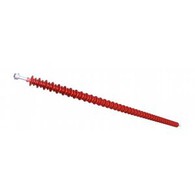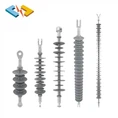

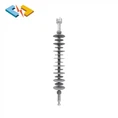

We're seeking forward in your check out for Polymer Post insulator for electrified railway, 35kV Composite Post Insulators, Composite Pin Insulator . Our products are manufactured to meet the most demanding specifications and requirements. Welcome to do bussines with us, let's be double win. In terms of new technologies to meet the needs of the future, our team of technical professionals continues to provide comprehensive support for product development and business activities with a forward-looking perspective.

Compared with ceramic insulator and glass insulator, 11kV and 10kV composite polymer insulators have high strength, light weight, higher wet flashover lightning voltage, operation and maintenance is more convenient; and they are not easy to break, reducing the accidental damage in the process of installation and transportation, and preventing the damage caused by human factors such as shooting.
Products technical datasheet
Model | Rated | Specified | Structure | Minimum Dry Arc Distance | Minimum | Lightning Impulse | Wet Power Frequency |
(kV) | (kN) | (mm) | (mm) | (mm) | ≥(kV) | ≥ (kV) | |
FXBW-10/100 | 10 | 100 | 400±5 | 228 | 630 | 110 | 40 |

knowledge
Pollution flashover and its process
During years of outdoor operation, the surface of the insulator will inevitably become dirty and dusty, which will gradually accumulate a layer of contamination. In humid weather, the contamination layer will become damp and become a conductive layer covering the surface of the insulator, eventually causing local arcing and It develops into surface flashover, which is called pollution flashover. Pollution flashover can be roughly divided into the following stages or processes.
(1) Deposition of filth
Under the influence of wind, gravity, electric field force and other factors, dust, fly ash and other contaminants in the atmosphere will approach and gradually deposit on the surface of the insulator. The shape of the insulator affects the air flow field around the insulator, which also has a significant impact on the accumulation of contamination on the insulator. Impact. The pollution on the surface of the insulator is mainly divided into industrial pollution such as dust from power plants, steel plants, and cement plants, exhaust gas from chemical plants, automobile exhaust, marine pollution such as salt particles in the wind in coastal areas, and saline-alkali land. Districts, farmland chemical fertilizers, natural pollution and agricultural pollution from residents’ lives.
The composition of pollution varies greatly depending on the region and pollution source. Although the composition of pollutants is complex, they can be generally divided into two categories: water-soluble conductive substances and water-insoluble inert substances.
After the insulator has been running for a period of time, a layer of dirt will gradually accumulate on the surface, and some of it will be washed away when the wind and rain are heavy. Therefore, dirt accumulation is actually a process of coexistence of dirt accumulation and self-cleaning.
(2) Dirty dampness
In the dry state, the contamination layer on the surface of the insulator has no significant impact on the flashover voltage along the surface. However, under humid climate conditions, such as fog, drizzle, condensation, melting snow, melting ice, etc., the dirt layer of the insulator will become damp, and the electrolyte components in the dirt will dissolve in the water to form a conductive water film. As a result, leakage current will flow along the surface of the insulator. The non-electrolyte components in the dirt act to absorb moisture. Although heavy rain also has a moistening effect on the pollution layer, it also plays a role in cleaning the pollution layer. Therefore, heavy rain is not the most dangerous meteorological condition for pollution flashover.
In heavy fog, drizzle, condensation, melting snow, melting ice, etc., the precipitation is not heavy but very humid, the pollution layer will gradually absorb moisture but not be lost, so it is the most dangerous meteorological condition for pollution flashover.
(3) Formation of dry zone and generation of local arc
Since the Joule heating effect of the leakage current will evaporate water, the current density is larger in some parts of the insulator and the thermal effect is significant, thus forming a dry area first. The emergence of the dry zone changes the voltage distribution along the insulator surface. Both ends of the dry zone are subjected to a large voltage. When the field strength somewhere in the dry zone exceeds the critical value of air discharge, a small arc along the surface will occur there. The form of discharge is related to the degree of dirt and moisture of the insulator. This type of discharge is very unstable and intermittent. The location and time of discharge are random. This intermittent discharge phenomenon may last for a long time. .
(4) Development of local arc and completion of flashover
Depending on the dirt and moisture conditions of the insulator, the development and changes of the local arc may gradually weaken and the insulator can continue to operate, or it may develop into a flashover between the two poles, causing a pollution flashover accident.
About factory and equipments


We are one of the top 8 polymer insulator manufacturers in China. Our insulators reached more than 50 countries, and got a good reputation in the world.
It is necessary to improve the quality of Long Rod Cross-Arm 33kv Polymer Insulator Bushing Composite Insulator to compete with similar products from other countries in the international market. Our company eagerly looks forward to establishing long-term and friendly business partner relationships with clients and businessmen from all over the world. 'Starting from customer needs, based on customer interests' is our commitment. We have maintained a long-term and good business relationship with many customers and established a good business image.
Hot Tags: 10kV composite long rod insulator, China, manufacturers, suppliers, factory, wholesale, for sale, 220kV station post insulator, Tension insulators, Suspension insulator, 69kV Composite Station Post Insulator, 10kV Pin Insulators, 33kv Post Insulator Drawing