


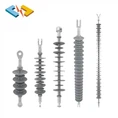

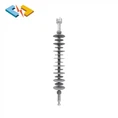


What is a post insulator? What are the functions of insulators?
Post insulator
Post insulator is a kind of special insulating control material, which can play an important role in overhead transmission lines. In the early years, pillar insulators were mostly used for electric poles, and later they gradually developed into high-voltage power line connection towers. Many suspension insulators are hung at one end to increase creepage distance. They are usually made of silicone or ceramic and are called insulators. Insulators play two basic roles in overhead transmission lines, namely, supporting conductors and preventing current from returning to the ground. These two roles require assurance. Insulators should not fail due to flashover breakdown caused by changes in environmental and electrical load conditions, otherwise they will lose their function and damage the service life of the entire line.
2. the function of the insulator
A number of disc-shaped insulators hang from one end of the high-voltage power line connection tower to increase creepage distance. They are usually made of glass, ceramic or rubber and are called insulators. In order to prevent floating dust and other dirt from sticking to the insulator surface, the path formed is broken down by flashover at both ends of the insulator, that is, creepage distance. Therefore, the surface distance, that is, creepage distance, increases. The distance along the insulation surface, that is, creepage distance, is called creepage distance. Climb distance = Surface distance/system limit high voltage. According to the pollution degree, the creepage distance of heavily polluted areas is generally 31mm/KV. The insulator is smooth, which can reduce the capacitive reactance between wires, so as to reduce the loss of current.
3, existing problems
With the construction of UHV AC /DC line and the continuous improvement of mechanical strength requirement in our country, the problem of pure porcelain post insulator becomes more and more prominent, especially at UHV DC converter station, mainly reflected in:
1. External insulation problems. With the deterioration of the operating environment, the anti-pollution flashover ability of porcelain pillar insulators is insufficient. For UHV DC, pure porcelain post insulators require large creepage distance and structure, but high post insulators are difficult to achieve strong bending and seismic strength.
2. The earthquake. It is difficult to solve the aseismic problem of the high voltage equipment with the insulator of electric porcelain pillar, which is referred to as electric porcelain type high voltage equipment. For UHVDC systems, the overall height of pillar insulators used in flat-wave reactors is required to be 12 meters, and the support weight should reach the standard of 40 tons. Obviously, porcelain pillar insulators are difficult to meet the anti-seismic requirements.
3. Manufacturing quality problems. Porcelain post insulators are difficult to manufacture because of their complex technology, equipment conditions, raw material quality problems and other reasons. On the basis of a large number of investigations, the accident investigation team of high voltage pillar porcelain INSULATOR of the power transmission Operation Department made statistics on the accidents of pillar porcelain insulator according to the technical reasons, and drew the conclusion that the breakage of pillar porcelain insulator was caused by the product quality.
How can substation post insulators be configured?
In order to achieve a good selection of post insulators for different substation applications, such as AIS disisolators, different technical parameters need to be considered. In detail, the important factors to consider when optimizing the size of an insulator are mechanical, electrical, environmental, functional, and economic.
Depending on the application, many different types of post insulators can be used in substations and substations, such as bus supports, flat wave reactor supports, switchgear, etc. Post insulators can be divided into three main categories:
1. Functional and electrical requirements
The main role of the disconnector is to ensure safety: in the disconnected state, it needs to provide a visible and reliable disconnect gap, while in the closed state, it needs to withstand the flow of normal and fault currents without interruption or abnormal unsafe conditions. In fact, disconnectors need to avoid discharging through open air gaps and the ground.
2. Mechanical requirements
From the mechanical point of view, in addition to its own working load, the disconnector also needs to bear external load. For example, one of the more critical conditions for UHV equipment is earthquake risk, so highly accurate design is required if all seismic requirements are to be met. Other loads to consider are short circuits, high speed winds, and terminal loads.
3. Environmental requirements
The disconnector is fully exposed to the environment and needs to withstand environmental factors, such as severe icing or heavy rain, which will increase the risk of discharge. It is important that contamination is a major factor in determining size, as insulation failure can lead to ground discharge.
All of these requirements have a great deal to do with the performance of the post insulator, which makes the rear insulator one of the important components in disconnectors and many other substation applications. Given other requirements related to displacement under load during use, disconnectors actually have another critical problem that other types of devices do not face, namely the movement of mechanical components required to open and close the device. Therefore, in order to make this kind of equipment work normally, it is necessary to have a certain prescribed stiffness.
In addition to the above limitations, there is a need to provide a compact and cost-effective solution for most of today's open-air substations. The development of post insulators can greatly contribute to this goal by limiting the necessary arc distances for buses, disconnectors, and other plant equipment. This can be achieved by optimizing the design of post insulators, for example, by choosing more suitable materials, improving mechanical strength and stiffness, reducing the number of stacked/intermediate flanges, and optimizing scaffold profiles and creepage coefficients.
What are the characteristics of post insulators?
In the past, rural areas used electric poles to support electric wires, and electric poles mostly used insulators, which gradually developed. A number of disc-shaped insulators are suspended from one end of the connecting tower of the high-voltage power lines to increase the leakage distance.
1. At present, the commonly used insulators are: ceramic insulators, FRP insulators, composite insulators and semiconductor insulators.
Second, the insulators used in overhead lines generally include pin insulators, butterfly insulators, suspension insulators, porcelain cross arms, rod insulators and tension-resistant insulators.
Three, according to the purpose can be divided into line insulator and power station and electrical insulation. Among them, the vulnerable insulators for line use are needle type, butterfly type and disc type, the non-vulnerable insulators are horizontal bar type and rod type suspension type, the vulnerable insulators for power station and electric appliance use are pin type post insulators, hollow post insulators and bushing, and the non-vulnerable insulators are rod type post insulators and container porcelain bushing.
Four, according to the structure can be divided into column (pillar) insulator, suspension insulator, antifouling insulator and casing insulator.
Insulators are usually divided into destructible and non-destructible types.
Compared with glass insulator, pillar insulator has the advantage of pillar porcelain vase mainly in that both of them have been used for more than a few years.
Due to the high mechanical strength caused by the material of the pillar porcelain vase, it is not easy to crack even if the outer shell surface is subjected to external forces. The e electrical strength of ceramics is very stable and can maintain a certain state in use. And because the aging rate of ceramic is slower than glass, glass insulators often become ceramic due to their own damage, and column porcelain bottles can run continuously for a long time.
When the prop porcelain is damaged, the cylinder cap and ceramic fragments will get stuck, but the remaining undamaged part of the prop porcelain can retain the internal insulator string due to its high mechanical strength. This is a link that many circuit engineering needs to examine when considering such products, and it is also the self-destruction rate of large grid insulation products.


Hot Tags: 69kv composite substation post insulators, China, manufacturers, suppliers, factory, wholesale, for sale


