


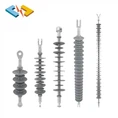

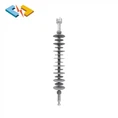
The insulator is made of porcelain and the upper and lower metal accessories are glued with glue. The contact parts between the end faces of the porcelain parts and the metal fittings are covered with elastic pads. The rubber parts of the porcelain parts are structured with sanding, knurling, digging, etc. to ensure mechanical strength and prevent loosening and twisting. The surface of the porcelain parts is evenly coated with white glaze, and the surface of the metal accessories is coated with gray magnetic paint.
The main structure of insulator porcelain has two types: cavity partition (breakdown type) structure and solid (non-breakdown type) structure. Insulators with integrated plastic pillars are generally solid non-breakdown structures. The latter structure improves safety and reliability compared with the former structure, and reduces the workload of maintenance and testing.
Insulator porcelain has two shapes, polygonal and polygonal. The polygonal shape increases the distance along the surface. The electrical performance is better than that of the polygonal shape. Except for the phase-out plastic insulators, the rest of the products are polygonal.
The internal glue structure, because the metal accessories are glued into the holes of the porcelain parts, the insulation distance is increased correspondingly, the electrical performance is improved, and the space occupied by the installation is also reduced, but because the internal glue is not good for improving the mechanical strength, so Insulators with high mechanical strength requirements should use joint glue (ie, the upper attachment uses inner glue and the lower attachment uses outer glue).
High-voltage line disc-shaped suspended porcelain insulators are used for the insulation and fixed conductors of high-voltage overhead transmission and distribution lines. They are generally assembled into insulator strings for lines of different voltage levels.
Ordinary type insulators are suitable for general areas. If the number of insulators is increased properly, the pollution flashover performance can also be improved.
Suspended porcelain insulators are made of porcelain, iron caps and steel feet made of silicate cement and quartz sand adhesive no less than 525. A thin layer of buffer layer is applied to the surface of the iron cap and the steel feet and the adhesive, and the top of the steel feet is elastically lined. White glaze and brown glaze are generally painted on the surface of porcelain parts, and other glazes can also be painted according to needs. All the heat on the surface of the iron cap and steel feet is zinc. There are two types of push-pull elastic locking pins, W-type and R-type, which are made of tin bronze, brass, and austenitic stainless steel. They have good elasticity and corrosion resistance, and are easy to disassemble and assemble. Slotted cylindrical and hump-shaped split pins. The former has a zinc surface heat, and the latter is made of brass. The above-mentioned elastic locking pins, cylindrical pins and other parts are supplied in complete sets with the product.
Insulators are divided into ball type and slot type according to the connection mode.
Normal and dirt-resistant insulators of the same strength grade use the same ball and socket connection dimensions to ensure interchangeability.