


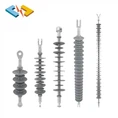


Line insulators are represented as voltage-dependent switches in lightning transient research. To mimic the flashover during lightning transients, there are various options, including:
Voltage threshold:
Based on a constant threshold value, the flashover occurs.
If the voltage across the switch is greater than the threshold, the voltage-dependent switch is closed.
The waveform and duration of the overvoltage have no bearing on the flashover voltage.
Volt-Time Curve:
A non-linear volt-time characteristic is used to trigger the flashover.
The volt-time characteristic represents the dielectric strength of the line insulator as a function of time during the transient.
If the voltage across the switch exceeds the volt-time curve, the voltage dependent switch closes.
The flashover voltage is proportional to the size and duration of the overvoltage. As a result, the waveform is taken into account.
Leader Progression Model (LPM):
The leader's physical model serves as the foundation for the flashover.
The voltage difference across the insulator serves as the basis for the leader propagation model.
If the leader length is greater than the length of the line insulator, the voltage-dependent switch is closed.
The flashover voltage depends on the overvoltage's magnitude and time length. Thus, the waveform is taken into account.