


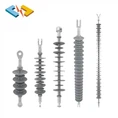

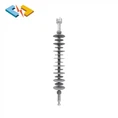

On October 14, the composite housing with series gap metal oxide arrester for ± 1100 kV transmission lines jointly developed by State Grid Anhui Electric Power Co., Ltd. and State Grid Electric Power Research Institute Wuhan Nanrui Co., Ltd. was installed on the 3-base iron tower of the Anhui section of the Jiquan Line. Installation and commissioning were completed and officially put into operation.
Summarize the law of lightning activity and assess the risk of lightning damage
At the end of 2018, the ± 1100 kV Jiquan UHV transmission line from Zhundong (Changji) Converter Station in Xinjiang and ending at Xuancheng (Guquan) Converter Station in Anhui was put into operation. The line passes through six provinces including Xinjiang, Gansu and Anhui, with a total length of 3,304.7 kilometers.
"In view of the importance of the Jiquan Line, before the line was put into operation, we studied the lightning protection measures of the line under the organization of the State Grid Equipment Department." Wei Min, director of the Transmission Department of the Anhui Electric Power Equipment Department of the State Grid, introduced, "In addition to taking lightning protection measures such as reducing the grounding resistance of the tower, we have carried out the research and development of ± 1100 kV lightning arresters. Because the equipment is used in the world's highest voltage level transmission lines, there is no reference for the relevant lightning protection work, and the research work faces many difficulties."
In January 2019, Anhui Electric Power Research Institute joined forces with Wuhan NARI Co., Ltd., Global Energy Internet Research Institute Co., Ltd., Tsinghua University, etc., to form a project team, starting from the lightning protection characteristics of ± 1100 kV transmission lines, the research and development and application of arresters, and the development and application of arresters. Start with the development and application of intelligent online monitoring devices and platforms to carry out lightning protection research.
"Lightning arresters can protect equipment on transmission lines from lightning overvoltage. In the first step, we statistically analyzed the lightning activity in the areas along the ± 1100 kV Jiquan Line, summarized the lightning activity rules, and carried out lightning threat and risk assessment across the line." Liu Jing said.
The project team counted the tower type, gear distance, tower height of the 6079 base tower along the Jiquan Line, as well as the topography, climate type, and altitude of the area where the tower is located. Lightning parameters such as ground flash density and lightning current amplitude of each base tower; considering the influence of ± 1100 kV operating voltage, analyze the rated voltage of the arrester, lightning impulse residual voltage and other parameters of the arrester; study the transient process of the arrester from one stable state to another under different installation positions, different lightning current amplitudes and various typical overvoltages.
Through a series of studies, the project team accurately grasped the distribution law of lightning risk and lightning impact along the ± 1100 kV Jiquan Line, and finally confirmed that the towers with higher lightning risk were mainly concentrated in the Anhui section, the Henan section and the Shaanxi section. There are 3 iron towers in Wuhu City, Anhui Province located in the section with the largest ground flash density on the whole line, and the lightning risk of 2 iron towers reached the highest D level.
"Class D means that the ground flash density is greater than 7.98 times/(square kilometer · year), and the lightning activity is the strongest." Liu Jing said, "Only by applying a reliable lightning protection system and installing lightning arresters with excellent performance can we reduce the risk of lightning damage on the line and ensure the safe and stable operation of the power grid."
Overcome problems one by one and successfully develop ± 1100 kV transmission line arrester
In January 2020, based on the lightning threat and risk assessment results of the entire ± 1100 kV Jiquan line, the project team started to develop a composite jacket with series gap metal oxide arrester for ± 1100 kV transmission lines.
Without considering the spatial and temporal differences of lightning activity, when the positive and negative conductors of the HVDC transmission line are struck by lightning, there will be a phenomenon that one polarity is more eroded than the other polarity, that is, the voltage polarity effect of the HVDC transmission line. Voltage polarity effect will cause the lightning flash rate of the positive conductor to remain high, resulting in single commutation failure or continuous commutation failure of the transmission line. This is the first problem that the project team needs to solve during the research and development process. The project team carried out the research on the HVDC transmission system, and proposed measures such as adjusting the synchronous modulator, adjusting the turn-off angle of the fixed-turn-off angle controller according to the fault characteristics, and reducing the trigger angle of the inverter-side converter to suppress the commutation failure.
The most important component inside the arrester is the resistor sheet. ± 1100 kV transmission lines have higher requirements for parameters such as the rated voltage of the arrester, the DC reference voltage, and the lightning impulse residual voltage of the arrester than ± 800 kV transmission lines. Therefore, the arrester installed on the ± 1100 kV transmission line needs a zinc oxide resistor sheet with larger capacity, lower residual voltage and stronger impact stability. The project team repeated tests to adjust the specific gravity of zinc oxide and other additives in the resistor sheet, and finally developed a resistor sheet with the characteristics of large capacity, small size and low residual voltage. " The height of this resistor is 4.4% lower than that of the ± 800 kV arrester resistor, the capacity is 11.3% larger, and the residual voltage ratio is also much lower than that of the ± 800 kV arrester resistor. "Liu Jing said.
The ± 1100 kV Jiquan line is mostly located in mountainous and hilly areas and is easily affected by moisture. When the project team developed the silicone rubber composite jacket of the arrester, the formula of the silicone rubber and additives was improved to ensure that the internal resistors of the arrester that have been placed in the wild for a long time are not damp and do not deteriorate.
In January 2021, the first domestic composite jacket metal oxide arrester with series gap for ± 1100 kV transmission line was rolled off the production line in Wuhan and passed the test.
In August this year, the State Grid Equipment Department organized experts to review the practice running plan of the arrester. Experts agreed that the arrester body has excellent performance, can act quickly under lightning overvoltage, release lightning energy, and prevent the air gap between the wire and the tower or the insulator string from being broken down. It has good lightning protection performance for ± 1100 kV transmission lines and can be connected to the network for practice running.
Select the optimal installation scheme, lightning arrester hanging network trial operation
After 10 days of hard work by more than 20 construction personnel, on October 14 this year, a composite jacket with series gap metal oxide arrester for ± 1100 kV transmission line was installed on the 3-base iron tower in the Anhui section of the ± 1100 kV Jiquan Line.
The arrester is 11 meters high and weighs about 1 ton. To install it firmly on the tower bracket more than 40 meters away from the ground, it is necessary to consider the side wind pressure it is subjected to to to ensure the stability after installation. In addition, the construction personnel must accurately control the air gap distance between the arrester and the wire of 2450 mm, allowing an error of only ± 50 mm.
Before installation, the project team, manufacturers, and construction personnel repeatedly discussed and proposed three installation solutions, namely erecting arrester towers, suspended installation, installing support brackets and using composite insulator strings for reinforcement.
"The first plan is expensive, the second plan needs to strengthen the structure of the iron tower, and it needs to pass through the wire during installation, which is difficult to construct." Liu Jing introduced, "In the third plan, the support bracket is connected to the main material of the iron tower, and the iron tower has small force and high safety; there is no need to pass through the wire to install, and the construction is difficult; the installation position is low, and the loading, unloading and maintenance are convenient." In the end, the third installation plan was approved by experts.
In order to monitor the operating status of the arrester and verify the application effect of the arrester, the project team also developed an intelligent online monitoring device to debug and access the device while installing the arrester. In the future, professionals from Anhui Electric Power Research Institute will use the device to monitor the operating status of the arrester, obtain information such as the operation time of the arrester, the number of lightning strikes, lightning current parameters and waveforms during the lightning strike of the line, accumulate the operation data of the arrester, and provide data support for the subsequent analysis of the operation effect of the arrester.