


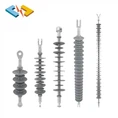

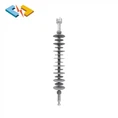
The structure of the line post and post composite insulator is similar to the rectangular composite insulator.
Hollow composite insulators can be used in oil-immersed capacitive bushings, SF6, bushings, circuit breakers, transformers, capacitors, wire ends, voltage dividers, surge arresters and other electrical appliances. Compared with porcelain sleeves, such hollow composite insulators have the advantages of small dimensional tolerances, light weight and high mechanical strength, and also eliminate the risk of cracking. In gas-filled electrical equipment, even if the insulator breaks, there is no threat to the surroundings.
The interface and connection structure are the parts of the composite insulator that have a long failure, and the design should consider that the tight connection between the interfaces does not allow air gaps. The air gap is the convergence point of moisture and partial discharge, which is easy to cause burn marks and erosion, and expose the new body to moisture to cause damage to the insulator.