




Quality is a measure of excellence and benchmarked in the electrical power industry using a variety of national or international standards such as ANSI, IEEE, IEC, ASTM, etc. While meeting these standards is of course critical, most have come to recognize that standards these days have come to represent only minimum performance requirements in an application. For this reason, manufacturers as well as users are looking to further differentiate product quality using enhanced specifications. Quality is also about manufacturing. In this regard, standards and continual process improvement focus on controls and repeatability with the goal of zero defects. Ultimately, quality has to represent product capability and longevity in addition to compliance with basic standards and customer specifications.
This edited contribution to INMR by Edward Niedospial, Technical Director–Transmission at MacLean Power Systems discusses these concepts when it comes to the production of insulators made of toughened glass.
The manufacture of toughened glass insulators can be considered as comprised of two key steps: manufacturing the glass shell; and then assembly of metal fittings onto that shell. Production requires specialized equipment and only a few manufacturers worldwide have the resources and experience to carry out both steps in a single production facility. In this regard, it is useful to study quality not only as it relates to manufacture of the toughened glass shell but also later during final assembly of the insulator.
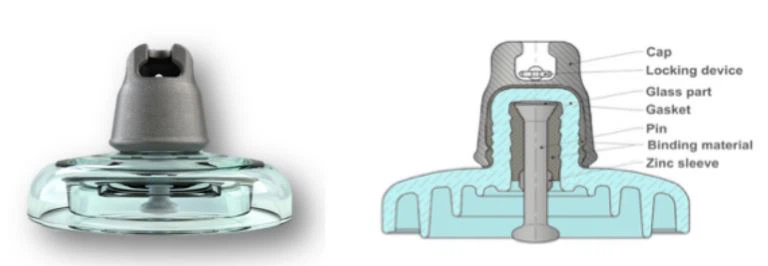
Fig. 1: Cut-away of toughened glass insulator shows shell, cap & pin, cement
The toughened glass shell comprises the actual insulator. While the fitting assembly and its cementing are important as well, this shell must remain intact over the entire service life in order to assure product functionality. Moreover, once assembled, occurrence of shell breakage not caused by some external event should be rare. For example, general industry expectation is that less than 1 per 10,000 installed units per year should shatter spontaneously. As such, incidence of self-shattering is one aspect of manufacturing that the factory must strive to minimize.
Apart from the critical shell, the hardware components of a toughened glass insulator include:
1. Caps
The cap at the top is a ductile iron socket fitting that has been galvanized and assembled with a stainless-steel locking pin.
2. Pins
The bottom pin fitting is a forged steel ball connection that has been galvanized and coated with bituminous tar. A sacrificial zinc collar can also be added for extended performance, especially in severe service environments.
Clevis/tongue fittings are sometimes used at lower voltages.