


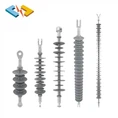

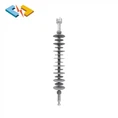
Insulator strings used in transmission lines will have many different assembly forms due to different tower structure, insulator type, conductor type, number of conductors per phase and voltage rating. But it can be divided into two types: suspension string and tension string.
Insulator strings consist of several branches, either suspension or tension. The entire assembly is called a "string" and the branches are called "links". When assembling accessories and insulators, the main issues to be considered are to determine the form and quantity of insulators, the assembly form of the insulator itself, the connection form between the insulator string and the tower, the connection between the insulator string and the wire, and so on. In addition, the mechanical strength of the fittings, the dimensional fit and orientation between the fittings need to be properly selected and checked.
The place where the conductor and ground cable are hung on the tower is called the hanging point. When selecting the hanging point of the insulator string, the hardware components connected to it should also be considered. The force on the lifting point is complex, and sufficient mechanical strength must be ensured in any case. In order to reduce or eliminate the bending stress at the lifting point, it is required that the hardware connected to the lifting point should be able to rotate flexibly with the change of the actual stress direction. There are many types of towers and insulator strings, and there are different types of hanging points, but they can be divided into two types: suspension type and tension type.
The insulator string is composed of insulators and power fittings. The insulators are divided into porcelain insulators, glass insulators and composite insulators. The insulator has good electrical insulation property, and the fittings are used to fix the insulator. The insulator has two functions: one is to firmly support and fix the current-carrying conductor, and the other is to form a good insulation between the current-carrying conductor and the ground. It must have sufficient dielectric strength and mechanical strength, and at the same time have sufficient resistance to the erosion of chemical impurities, and can adapt to changes in the surrounding atmosphere.
Insulator strings used in substations and overhead lines include pin insulators, post insulators, porcelain cross arm insulators and high-voltage wall bushings.
If the general insulator string cannot meet the clearance of the tower body, the jumper insulator string composed of jumper brackets (commonly known as pole clamps) can be used to keep the jumper away from the tower body. The jumper bracket has two structures, one is using angle steel as a bracket, the ends of the angle steel are pressed into an arc shape, and the jumper is fixed with four hook bolts; the other is a bracket made of angle steel, with two suspension clips hanging below the bracket . However, the jumper brackets of these two modes are a little floating, and the stability is poor. In case of oblique wind force or careless construction and installation, it will affect the electrical clearance between the jumper and the tower. In order to improve this situation, the suspension insulator string with jumper can also be hung on the tower by two single strings and two points, which overcomes the shortcoming that the pole clamp is too flexible.