


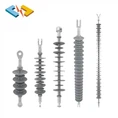

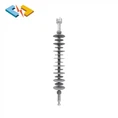
Composite long rod insulators
Composite long rod insulators are primarily used in suspension strings in straight-line supports and as tension strings in anchor towers and dead-end towers. They are also used in the jumpers or portals of outdoor substations. In some cases, composite long rods are used in the guys of wooden poles, and more rarely in the guys of steel towers.
Composite post insulators
In contrast to composite long rods, composite post insulators are subjected mainly to loads which act perpendicular to the longitudinal axis of the insulator and thus produce bending stresses over the cross-section of the insulator. As a result of this bending load, composite post insulators use FRP rods of substantially greater diameter compared to composite long rods. Typical applications of composite post insulators include distribution insulators, vertical and horizontal line posts, busbar support insulators and railway catenary insulators.
Interphase spacers
Line compaction is primarily based on the principle of minimising interphase spacing. As a result of this, and also since the interphase spacings are somewhat smaller than those encountered in the case of normal overhead transmission lines, there is greater risk of interphase flashover with a compact design when two conductors are moved close to one another, for example as a result of wind, ice shedding or short circuit; this may lead to an interruption in service. Interphase spacers (IPS) are used to avoid this.
Composite hollow core insulators
Composite hollow core insulators (referred to hereinafter as HCI for short) are used primarily as housings for various high-voltage equipment and apparatus. Owing to their conditions for use, they primarily have to withstand bending and compression loads and since a large number of the electrical equipment are gas insulated (with SF6 and SF6 gas mixtures), they are also subject to internal pressure. Today, if the user so desires, it is possible to design complete substations in silicone composite technology.