


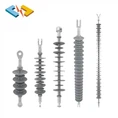

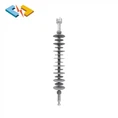
An insulator string is an assembly in which two or more insulator elements are grouped together to flexibly suspend a wire. An insulator string is a protective device with fixed and operational requirements, used to suspend conductors and insulate them from the tower and ground.
The assembly type of insulator string used in transmission lines is different due to the differences in tower structure, insulator structure type, wire size, number of lead wires in each phase and voltage level.
Dangling insulator string
Pendant insulator strings are only applicable to linear towers (or jumpers of tensioned towers). Figure 2-7 shows single pendant insulator strings. In normal operation, it only bears the wire and the additional vertical load and wind load. In the case of accident, it should bear the wire breaking tension of the wire. So a dangling insulator string has to satisfy both of these conditions.
Because of the different vertical load, each phase of the suspended insulator string may be assembled in different modes of single string, double string or multiple string. The use of single insulator string has many advantages: (1) the need for a small number of tools and insulators, the cost is lower; (2) The corresponding damage rate is also less, the cost of replacement, maintenance and overhaul is also reduced; (3) Because the flashover probability is proportional to the number of insulators and the number of strings, the number of insulators is reduced, so the flashover probability is lower. However, the reliability of a single insulator string is low once there is a damaged insulator in the string. Generally, double or multiple insulator strings can be used in places with large gap, serious force and important crossing. After the use of double insulator string, the string length will be increased, and the height of the pole will be reduced by 0.3 ~ 1m. Therefore, the general use of single suspension insulator string. Only when the vertical load is large and the strength of a single string cannot be met, or in important crossings, it is necessary to use double or multiple insulator strings. Sometimes, in the mountains when the overhang Angle can not meet the requirements, also used double double clip.
Tensioning insulator string
The stress situation of tensioning insulator string is completely different from that of dangling insulator string. Under normal operation, dangling insulator string only bears vertical load and does not bear wire tension, while tensioning insulator string is just the opposite, it mainly bears all horizontal tension of wire.
As with dangling insulator strings, when the number of insulated sub-strings required for each string is determined, the method of hanging points should be selected. Because the hanging point is the place where the stress of the insulator string is concentrated, we should choose the hanging way with simple structure, flexible rotation, convenient construction and clear stress. Because of this, although there are many ways of hanging overhead transmission lines, there are usually two main ways of hanging one point square and two points. These two ways of hanging wire can rotate freely up and down and left and right, so this hanging wire structure is suitable for the change of the corner, and suitable for the needs of the downward Angle of the wire.
V insulator string
There are many types of V-shaped insulator assembly, and V-shaped insulator string is a common one. The use of V-shaped insulator string has the following advantages:
(1) can limit the swing of insulator string, thus reducing the size of tower head;
(2) It can narrow the line corridor, thus reducing the width of tree cutting in the forest area, but also improve the excavation of mountain slope;
(3) It can reduce the cost of purchasing corridors when building lines, so as to save investment.
However, on the other hand, the use of V-shaped insulator string will double the insulator requirement. Therefore, V-shaped insulated substring is generally used in the glass type, door type, cat head type medium phase wire limited by the tower window. If it is used in the side phase, it is not economical to make the side phase cross arm longer, so comprehensive technical and economic comparison should be made before the use of V-shaped insulator string. When the old line transformation or booster line, the use of V-shaped edge substring is more suitable.
Chain insulator string
With the increasing voltage level of transmission lines, there is also a kind of chain-shaped pole tower of insulator strings. The insulator string not only plays the role of insulation, but also replaces the pole and tower cross arm, which omits the complex steel structure cross arm. If the cross arm is replaced by the synthetic insulator, it also has the advantages of light weight, light transportation, small storage place, convenient construction and so on. As the pole tower of high-voltage transmission line, especially the pole tower for emergency repair, it is very suitable. This kind of tower type is also useful in our 500kV compact line.
As the insulator string is a flexible composite component, it cannot withstand pressure, so when the chain type insulator string is used as this kind of tower, the insulator string should also be shielded from pressure.