





Internal structure of transmission line composite insulators
Composite insulator
1.1 Shape (umbrella type)
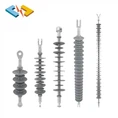
Composite insulators are easy to form and have a variety of umbrella structures. The parameters to describe the umbrella structure of composite insulators include the shape parameters of umbrella skirts such as inclination Angle and elongation ratio, as well as the arrangement and combination modes of large and small umbrellas in an umbrella skirt unit, such as equal diameter umbrella, large-small umbrella, large-small-medium-small-small umbrella, and so on.

Figure Different composite insulator umbrella group units
There is no edge under the composite insulator umbrella. The arrangement of different sizes of umbrellas has little influence on insulator fouling, but has a significant impact on the anti-ice performance. Too close to the large umbrella will make the insulator easier to be bridged by ice edges, resulting in a drop in ice lightning pressure.
1.2 Internal Structure
① Overall structure
Composite insulator is composed of mandrel, umbrella skirt sheath and connecting fittings. The material of the manger is glass reinforced plastic, which is used to provide the mechanical properties of the insulator. The sheath is connected to the surface of the manger through adhesives to protect the manger. The connecting metal tools are located at both ends of the composite insulator to connect the composite insulator with the pole and tower gold tools.

Figure Overall structure of composite insulator
(2) End structure
Composite insulator can be divided into wedge type structure, bonding type structure and crimping type structure according to the end structure. At present, most of the composite insulators in transport are of crimped type structure, only a few of them are wedge type structure.
1) wedge structure and seal
Wedge structure can be divided into inner wedge type and outer wedge type. See FIG. for the schematic diagram of its structure.


Figure Wedge structure of composite insulator
As shown in the right side of Figure, a slot is cut on the mandrel, and the slotted mandrel is inserted into the inner hole of the tool. A tapered wedge is pressed into the mandrel groove to produce a certain friction between the mandrel surface and the inner wall of the tool, so that the composite insulator can bear a certain mechanical tensile load.
The outer wedge structure is shown in the left part of Figure . The mandrel is inserted into the inner hole of the tool. A plurality of tapered wedges are pressed between the mandrel and the inner hole of the tool. To form a certain friction between the tool and the wedge and the mandrel. The composite insulator can bear a certain mechanical tensile load.
The sealing of wedge structure is shown in Figure , in which the structure in Figure relies on sealant to seal the mandle-rod and the gold tool, and the screw thread is generally used to connect the mandle-rod and the gold tool. In Figure , a sealing ring is added between the mandle-rod and the gold tool, and the sealing is achieved with the compressed sealing ring and sealant. The sealant used above is generally vulcanized silicone rubber at room temperature.


Figure Wedge structure end sealing type
There are several seals between mandrel and fittings 1 (sleeve), and between fittings 1 (sleeve) and fittings 2 (iron cap) in the above structure, which increases the probability of seal failure. The normal temperature vulcanized silicone rubber used is easy to aging and cracking, resulting in the invasion of water.
2) crimp type structure and seal
The crimping structure is shown in Figure. The metal material is made into a gold tool with a cylindrical cavity, and the gold tool is set on the end of the mandrel. Through automatic crimping equipment, appropriate pressure is applied to the outer circumference of the metal tools in multiple directions, so that the metal tools appear plastic and are set on the end of the mandle-rod, so that the composite insulator can bear a certain mechanical tensile load.

Figure crimped end structure
The crimped end structure of composite insulators used in Zhejiang region is shown in Figure Figure shows a groove in the inner cavity of the tool. A sealing ring is pressed between the sheath and the groove of the tool, and the outer part is sealed with RTV silicone rubber. Figure shows the sealing ring added to the end of the fittings, and the sealing ring is pressed into the ring. Figure shows that the high temperature vulcanized silicone rubber is directly extruded on the mandels and the metal tools by the integral injection molding process, and the surface of the metal tools is also set with grooves to increase the sealing reliability.

Figure crimped structural seal type
Wedge structure more complicated structure, sealing interface, easy into the wedge can cause damage to core rod, does not favor the long-term maintenance of core rod mechanical properties, were often happened in the history of wedge structure of composite insulator end water caused by seal failure and, in turn, cause the brittle fracture cases, no longer manufacture at present, only some of the old in the composite insulator for wedge structure.
The crimping type has the advantages of simple structure, good sealing property, uniform force during crimping and will not damage the mandle-rod. At present, the crimping process is adopted in the production of composite insulators. After more than ten years of operation, there is almost no end seal failure problem.
Hot Tags: 138kv composite substation post insulators for t/d, China, manufacturers, suppliers, factory, wholesale, for sale


