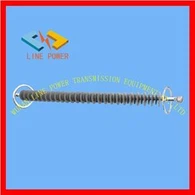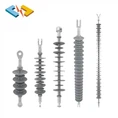

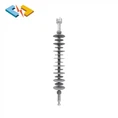

Composite Polymeric Insulator 230kV 160kN with Corona Rings
Products Description
230kV composite polymric insulator

|
Model |
Rated |
Specified |
Structure |
Minimum Dry Arc Distance |
Minimum |
Lightning Impulse |
Wet Power Frequency |
|
(kV) |
(kN) |
(mm) |
(mm) |
(mm) |
≥(kV) |
≥ (kV) |
|
|
FXBW-230/160 |
230 |
160 |
2350±30 |
2001 |
6905 |
1000 |
395 |
knowledge
Insulator pollution flashover and its hazards
Pollution Flashover occurs when contaminants accumulate on the surface of an insulator (external insulation) of electrical equipment. In humid conditions, soluble substances in the pollution dissolve in water, forming a conductive layer on the insulator surface, which significantly reduces its insulation capability. When exposed to a strong electric field, this can lead to severe electrical discharges.
Consequences: Pollution flashover can severely impact power systems. When such incidents occur, the likelihood of successful reclosing is very low, often resulting in widespread power outages. Additionally, the intense arcs generated during a pollution flashover can cause significant damage to electrical equipment.
Conventional insulator anti-pollution flashover measures
(1) Increase the climbing distance
Pollution flashover is a surface discharge, which is different from slip flash. Increasing the surface distance (also called creepage distance) can directly increase the surface resistance, suppress the current, and increase the flashover voltage. Therefore, for suspension insulator strings, methods such as increasing the number of pieces or using large creepage insulators are commonly used.
(2) Strengthen cleaning
Regular or irregular cleaning and manual removal of contamination on the insulator surface can certainly increase the flashover voltage. Regarding my country's pollution and meteorological conditions, the most effective season for cleaning is in winter when pollution is serious and precipitation has not yet arrived. Live cleaning is generally only suitable for substations with centralized equipment and convenient transportation, and there is a danger of flashover caused by improper flushing of live water. For transmission lines, manual cleaning is required during a power outage. You have to go up to the tower manually and wipe them with a wet cloth. The workload is huge, the working conditions are extremely poor, and in the wild, the cleaning effect is also very unstable and very unsatisfactory. Foreign countries have not completely abandoned this method, but only use some mechanical tools.
(3) Use silicone oil, floor wax and other coatings
Coating a layer of hydrophobic substance on the surface of the insulator prevents the wet dirt layer from forming a continuous conductive film, suppresses leakage current, and thereby increases the flashover voltage. However, these paints often have a short lifespan. It is very troublesome to apply them in the autumn and then wipe them off again in the spring.
factory direct


We are certified by ISO 9001:2015, ISO 14001:2015 and ISO 45001:2018. And we have full range type test reports which issued by third part labs.. We also have KEMA reports.

Hot Tags: Composite Polymeric Insulator 230kV 160kN with Corona Rings, China, manufacturers, suppliers, factory, wholesale, for sale, 33kv polymer disc insulator, 400kV Composite Long Rod Insulator, 110kV Composite Suspension Insulator, Composite Suspension Insulator, Silicone Rubber suspension Insulator, Polymeric suspension insulators