


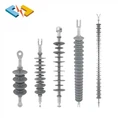

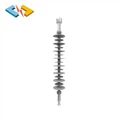


Dead end insulators

technical Data Sheet
Rated Voltage | Height | Dry Distance | Min. Creepage Distance | End Fittings | SML | RTL | Wet Power Frequency Flashover Voltage | Lightning Impulse Flashover Voltage |
45 | 630±10 | 470 | 1050 | Clevis/Tongue (CT) | 70 | 35 | 157 | 330 |
Reference Drawing

Products Description
We have our own silicone rubber production workshop, we could provide kinds of colors for the insulators: Grey, Red, Green, ..., Customized. Below is our rubber parameters:
Item | Requirements | Measured Valued |
Visual examination | Fuchsine, grey or white, no obvious mechanical admixture. Vulcanized silicon rubber with dense and smooth cutting surface. | Ok |
Hardness (shore A) | ≮50 | 65~70 |
Tensile strength (Map) | ≮4 | 4~6 |
Failure elongation (%) | ≮150 | ≮180 |
Tearing strength (kN/m) | ≮10 (right angle sample) | 12~15 |
Volume resistivity (Ω.m) | 1X10¹² | 3~8X10¹² |
Puncture strength (kV/mm) | Alternating current ≮22 | ≮30 |
Tracking and erosion | TMA4.5,erosion depth≯2.5mm | TMA4.5, erosion depth <0.8mm |
Flammability (Grade) | FV-0 | FV-0 |
Technology characteristics for Silicone Rubber Housing:
Better hydrophobicity
Better hydrophobicity migration performance
Better pollution resistance
Excellent electrical insulation properties
Excellent aging resistance
Identification of the dead end insulator
Each insulator is marked with the trade of the manufacture or the supplier, the year of manufacture, the specified mechanical load, insulator serial number.

Routine tests(each insulator shall be examined)
Ø Test Standard for long rod insulators: IEC61109 Suspension and Tension insulator for AC with a nominal voltages greater than 1000V--General definition, test methods, acceptance criteria and enterprise standard.
5.1 Visual examination
The mounting of the end fittings on the insulating parts shall be in accordance with the drawings. The colour of the insulator shall be approximately as specified in the drawings. The markings shall be in conformance with IEC 61109 and client’s requirements.
The following defects are not permitted:
a) superficial defects of an area greater than 25 m㎡ (the total defective area not to exceed 0,2 % of the total insulator surface) or of depth greater than 1 mm;
b) cracks at the root of the shed, notably next to the metal fittings;
c) separation or lack of bonding at the housing to metal fitting joint;
d) separation or bonding defects at the shed to sheath interface,
e) moulding flashes protruding more than 1 mm above the housing surface.

5.2 Tensile load test (RTL)
Every insulator shall withstand 50% SML.


Trends and Prospect
In order to ensure safe and dependable power transmission and distribution, the insulator industry plays a crucial role in the power sector. The energy business is anticipated to increase significantly over the next several years as a result of rising energy demand and rising use of renewable energy sources.
The expansion of the electricity sector in emerging economies is one of the key factors driving the insulator industry's growth. New transmission and distribution infrastructure, including insulators, are required to meet the rising demand for electricity in nations like China and India. Insulator producers have a great potential to take advantage of this expanding demand and increase their market share.
Adoption of renewable energy sources like wind and solar power is another trend boosting the insulator industry's growth. New transmission infrastructure is needed for these energy sources so that it can handle their special qualities, such variable power output. Insulators are crucial parts of this infrastructure since they help to guarantee secure and dependable power transmission.
Along with these changes, there is an increase in demand for insulators that provide better performance and durability. For instance, because to their greater mechanical strength, weather resistance, and pollution resistance, composite insulators are growing in popularity. They are perfect for severe settings and demanding working conditions thanks to these qualities, and it is anticipated that they will overtake other insulator options in the years to come.
Hot Tags: Polymer Dead end insulators 45kV, China, manufacturers, suppliers, factory, wholesale, for sale, 35kV Composite Deadend insulators, Polymer Deadend Insulator, 25kV Composite Deadend insulators, 115kV Composite Deadend Insulators, 138kV Composite Deadend Insulators, 15kV Composite Deadend insulators


