




Products Description
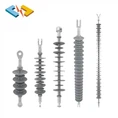
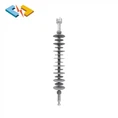
Composite Railway Insulator

| Rated Voltage (kV) |
Section Length (mm) |
Dry Arcing Distance (mm) |
Leakage Distance (mm) |
Specified Cantilever Load (SCL, kN) |
Max. Design Cantilever Load (MDCL, kN) |
1min. Power Frequency Withstand Voltage (Wet, kV) |
Lightning Impulse Withstand Voltage (kV) |
| 25 | 800±20 | 555 | 1600 | 16 | 8 | 150 | 310 |
Synthetic insulators for electrified railways have compact structure, strong integrity, good anti-fouling ability, light weight, small size, good internal and external insulation properties, high mechanical strength, and do not require regular cleaning. They are mainly used in the construction of high-speed railways and urban light rail transportation, providing Storage, transportation, installation and maintenance bring great convenience.
Products Knowledge
Analysis and preventive measures on insulator flashover of electrified high-speed railways
Catenary lines are an important part of electrified railways. They are erected in the open air along the lines and are affected by the natural environment and the surrounding operating environment. As an electrical insulation component of the catenary, the state of insulators directly affects the power supply of the catenary and the operation of electric locomotives and EMUs. Due to the existence of industrial pollution, the discharged dust falls with the wind and adheres to the contact network insulators, causing contamination on the surface of the insulators. In rain, snow, and foggy weather, pollution flashover occurs on the insulators under normal operating voltage, causing large-area and long-term damage. Timed power outage is one of the frequent accidents in electrified railways. Therefore, we should analyze the factors affecting the pollution flash discharge of insulators, understand the rules of pollution on the surface of insulators, strengthen insulation management and take targeted preventive measures to minimize the impact of pollution on electrified railways. transportation is of great significance.
Analysis of insulation pollution rules
There is a process of accumulation of dirt on the surface of insulators, which is directly related to the installation, suspension method and location of the insulator. As shown in Figure 1 below, the degree of contamination of the upstream and downstream insulators in the same section is different, and the degree of contamination of the insulators with additional suspended, flat, and oblique arm arms on the same pillar is also different, resulting in the oblique arm arm. There are differences in the flashover of insulators with flat wrist arms and additional suspension under the same voltage.
1. Different analysis of contamination on upstream and downstream insulators
In the double-track electrified railway section, the pollution source is on one side of the line. When the wind blows from the side of the pollution source to the line, the rod insulators installed in the upper and lower rows will have a row of insulator umbrella groups smoothly facing each other due to different installation methods. In the direction where the wind is blowing, the other row of insulators has the grooved side of the umbrella group facing the direction of the wind. The relatively smooth surface of the umbrella group with grooves is more likely to cause dust pollution to accumulate in the long term. This has caused one row of insulators to be dirty relative to the other row, and the density of salt attached to the surface of the insulators has also increased accordingly, resulting in a large area of fog flash tripping for one row of insulators in bad weather such as fog and snow, affecting power supply and driving.
2. Different analysis of contamination on flat and inclined insulators
In the triangular structure of the wrist arm installation, the angle between the oblique wrist arm insulator and the pillar is generally 60? During installation, the flat arm insulator is installed perpendicularly to the pillar. When the wind blows over with polluted dust, the windward area of the inclined arm insulator is approximately one-half of the surface area of the rod insulator, 0.40m? , the windward area of the flat wrist arm insulator is one-ninth of the surface area of the rod insulator, which is 0.07m? . Comparing the windward area, the area of angled arm insulators is nearly five times that of flat arm insulators, so insulators with angled arms are more likely to accumulate dirt than insulators with flat arms. As a result, insulators with oblique wrist arms have a higher chance of fog flash in bad weather such as fog and snow. The additionally suspended insulator is in a vertical state. Compared with the insulator with an inclined arm, the installation angle of the inclined arm is more likely to cause dust to fall and accumulate.
On-site data statistics and test analysis
On February 22, 2012, heavy fog with visibility less than 20 meters occurred on the Beijing-Shanghai High-Speed Railway between Tianjin South and Cangzhou West. A total of 7 catenary tripping occurred. The fault points were mainly distributed between K145+887 and K163+887. The fault point distribution indefinite. Through the work area, the site was inspected under the bridge, the rail car was inspected online, and the work area personnel were inspected on the high-speed train. No obvious fault points were found. Combined with the foggy weather with visibility less than 20m at the time, it was initially determined that the cause of the trip was a large area of insulator fog flash leakage that caused the trip. The skylight inspection revealed 7 insulator flashovers, including 6 oblique wrist arms and 1 flat wrist arm. The flashover insulators were all downward. Analysis and testing based on on-site inspection conditions are as follows:
(1) Conduct a salt density test on the replaced flashover insulator. The test value is 0.12㎎/-0.13㎎/. A heavily polluted area with a salt density of 0.1-0.3㎎/ is used to determine the area where the flashover insulator is located. This section is a heavily polluted area.
(2) Through investigation, it was found that the pollution source (brick factory, steel plant industrial park, etc.) is on the downstream side of the flashover section. The oblique wrist arms on the up and down sides are at an angle of 60 degrees with the pillars. When the wind blows from the downward side to the upstream side, the contact area of the oblique wrist arms with the pollution source is larger than that of the flat wrist arms. Therefore, the dust fall area of the oblique wrist arms is larger and the dirt accumulation ratio is larger. Flat-wrist insulators are easier to use and accumulate more dirt. At the same time, when encountering heavy rain, both the upper and lower sides of flat-wrist insulators can be washed away by rainwater. Their self-cleaning properties are better than those of oblique-arm insulators, so oblique-arm insulators are better than flat-arm insulators. The arm is prone to flashover.
(3) When pollutants blow over with the wind, the windward area of the downward inclined arm insulator is 0.40m? , is half the surface area of the insulator, and the groove side of the porcelain group is in the direction of wind blowing, which is more likely to cause the accumulation of contaminated dust; the wind blowing area of the upward side inclined wrist arm insulator is less than 0.07m due to the installation angle? , and the surface of the porcelain group is facing the direction of the wind, and compared with the downward insulator, the degree of pollution accumulated by the polluted dust is smaller, so the pollution on the downward side is more serious than that on the upward side.
(4) The air humidity is relatively high in late winter and early spring. In foggy weather, there are water droplets on the surface of the insulator. On-site observation found that the water droplets formed on the surface of the flat wrist arm insulator dripped on the oblique wrist arm insulator, and at the same time, the flat wrist arm insulator The pollutants in the arm insulators are superimposed on the oblique arm insulators, which reduces the insulator's resistance to pollution lightning voltage, causing oblique arm insulators to be more prone to pollution flash tripping than flat arm insulators.
Hot Tags: 25kv composite railway insulator, China, manufacturers, suppliers, factory, wholesale, for sale, Composite Braced Line post Insulator, 33kv post insulator, insulator line post, 132kv Post Insulator, post insulator and pin insulator, ANSI line post insulator


