


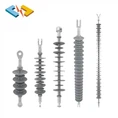

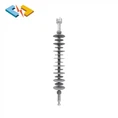

Products Description
Composite Line Post Insulator with Horizontal Clamp

| Rated Voltage (kV) |
Section Length (mm) |
Dry Arcing Distance (mm) |
Leakage Distance (mm) |
Specified Cantilever Load (SCL, kN) |
Max. Design Cantilever Load (MDCL, kN) |
1min. Power Frequency Withstand Voltage (Wet, kV) |
Lightning Impulse Withstand Voltage (kV) |
| 69 | 890±30 | 640 | 1800 | 11.1 | 5.6 | 150 | 350 |
Products Knowledge
Electrical 12 common problems and solutions 1-6
Lightning protection grounding does not meet the requirements
1. Phenomenon
(l) There are defects such as slag inclusions, welding nodules, weak welds, flesh bites, and incomplete welds at the overlapping areas of down conductors, voltage equalizing rings, and lightning protection strips.
(2) Do not knock off the welding slag and do not apply anti-rust paint on the welding area on the lightning protection belt.
(3) Use rebar instead of round steel as lap steel bars.
(4) Directly use the butt-welded main steel bars for lightning protection and alignment.
2. Cause analysis
(1) The operators do not have a strong sense of responsibility and are not skilled in welding technology. Most of them are generalist welders in the electrician class and have poor operating skills in opposition welding.
(2) The on-site construction manager did not implement the relevant provisions of the national construction and acceptance specification GB501692 "Grounding Device".
3. Preventive measures
(1) Strengthen the skill training of welders, requiring the lap welds to be full, flat and even, especially for more difficult weldings such as vertical welding and overhead welding.
(2) Enhance the sense of responsibility of managers and welders, promptly repair unqualified welds, knock off welding slag promptly, and apply anti-rust paint.
(3) According to GB501692 "Code for Construction and Acceptance of Grounding Devices in Electrical Installation Engineering", the connection of lightning protection down conductors is lap welding, and the lap length is 6 times the diameter of the round steel. Therefore, rebar is not allowed to be used instead. Round steel is used as lap steel bar. In addition, if the main steel bars used as down conductors are butt welded, an overlapping round steel should be added to the butt welding location as required.
Outdoor entrance management does not meet the requirements
1. Phenomenon
(1) Use thin-walled copper pipes instead of thick-walled steel pipes.
(2) The embedded depth is not enough and the position deviation is large.
(3) Use electric welding to bend the corners, and connect the upper wall pipe and the horizontal entrance pipe network to form a 90° angle with electric welding.
(4) The waterproofing treatment of the entrance pipe and basement exterior wall is not good.
2. Cause analysis
(1) Material buyers are not familiar with national norms and standards when purchasing, and some construction units deliberately confuse them to reduce costs; construction managers are not strict or do not dare to object to contractors' intentional violations, and do not resolutely implement norms and standards. ; There are loopholes in the management of materials entering the site by supervisors.
(2) Insufficient coordination with civil engineering and other professional teams.
(3) If you don’t have a pipe bending machine or don’t know how to use a pipe bending machine, you don’t have a strong sense of responsibility and just use electric welding to make bends for convenience.
(4) The workers who embedded the household pipes did not understand waterproofing technology and did not ask waterproofing professionals for help.
3. Preventive measures
(l) The embedded pipe entering the house must use thick-walled copper pipe or PVC pipe that meets the requirements (generally the wall thickness of PVC Φl14 is more than 4.5mm, and Φ56 is 3mm).
(2) Strengthen coordination and cooperation with civil engineering and other related professionals, clarify the elevation of the outdoor floor, and ensure that the buried depth of the embedded pipes is not less than 0.7 meters.
(3) Strengthen the education of contracting team leaders and material purchasers on relevant laws and regulations. Supervisors must strictly implement the requirement that materials must be inspected before entering the site to plug loopholes.
(4) The elbows of embedded steel pipes on the wall must be bent with a pipe bender, and welding and welding bending are not allowed. After bending, the steel pipe should not have cracks or obvious dents. The bending procedure should not be greater than 10% of the outer diameter of the pipe, and the bending radius should not be less than the minimum allowable bending radius of the cable being penetrated.
(5) Do a good job of waterproofing. Ask waterproofing professionals to provide on-site guidance or have a professional waterproofing team do the waterproofing.
The laying of electrical wire pipes (steel pipes, PVC pipes) does not meet the requirements
1. Phenomenon
(1) The cable tubes overlap in multiple layers, and in some places they are higher than the reinforcement of the steel bars.
(2) Two or more wire conduits are closely connected side by side.
(3) The depth of the electrical conduit buried in the wall is too shallow, or even buried in the powder layer outside the wall. The pipe has dead bends, painful breaks, and dents.
(4) The wire pipe enters the distribution box, and the pipe opening is not filled smoothly inside the box.
Exposed too long; the tube mouth is uneven and of different lengths; the tube mouth does not require a protective ring; it is not locked and fixed.
(5) When pre-embedding PVC wire pipes, instead of blocking the pipe with a plug, use pliers to flatten and bend the pipe mouth.
2. Cause analysis
(1) The construction workers are not familiar with the relevant specifications, have a sloppy work attitude, are greedy for convenience, and do not follow the regulations. The construction manager's management is not in place.
(2) Insufficient coordination between the architectural design layout and electrical professionals resulted in multiple wire pipes passing through the same narrow plane.
3. Preventive measures
(1) Strengthen the quality control of the construction process of on-site construction personnel and conduct targeted training for workers; managers must be familiar with relevant specifications and manage them strictly.
in a common channel. When there are more than 6 residential units on each floor of a tower, it is recommended that the civil construction adopts the tight decoration method of the ceiling of the public corridor, so that most of the entrance wires of the electrical industry can directly enter the residents through the wire ducts laid on the suspended ceiling. It is also possible to thicken the floor slabs of public walkways so that numerous electrical conduits can be concealed. When laying pipes, professional electrical construction personnel should try to minimize the number of overlapping layers of wire pipes at the same point.
(3) The wire layers cannot be close together. If it is difficult to separate them clearly during construction, small cement blocks can be used to separate them.
(4) Electrical conduits are buried in brick walls, and the distance from the surface should not be less than 15mm, and the pipes should be laid "horizontally and vertically".
(5) The bending radius (hidden burial) of the electric wire tube should not be less than 10 times the outer diameter of the pipe. When bending the pipe, use a pipe bender or a bender to make the bend flat and smooth without flat folds, dents, etc.
(6) The wire tube should be flat when entering the distribution box, with an exposed length of 3-5mm. The tube opening should be sheathed and the box shell should be locked. When entering the wire conduit of the floor-standing distribution box, the pipe opening should be 50-80mm higher than the base surface of the distribution box.
(7) When pre-embedding PVC wire pipes, it is prohibited to use pliers to flatten or bend the pipe mouth. Use a PVC plug that matches the pipe diameter to cover the pipe mouth and tie it firmly with tape.
The wiring, connection quality and color code of the wires do not meet the requirements
1. Phenomenon
(1) Multi-strand wires do not use copper connectors and are directly made into a "sheep's eye" shape without tin expansion.
(2) When connecting to the terminals of switches, sockets, and distribution boxes, connect several wires to one terminal.
(3) The wire ends are exposed, the wires are not arranged neatly, and there is no bundling.
(4) The color codes of the three-phase wires, neutral wire (N wire), and ground protection wire (PE wire) are inconsistent or confused.
2. Cause analysis
(1) The construction workers are not proficient in the wiring process and technology of wires.
(2) The material purchaser did not prepare the various wire colors and quantities required for construction as required, or the construction management staff mixed them in order to save materials.
3. Preventive measures
(1) Strengthen construction personnel’s learning of standards and skill training.
(2) When connecting multi-strand wires, galvanized copper connectors should be crimped. Try not to make a "sheep's eye" shape. If so, they should be tinned evenly.
(3) Only one wire should be connected on the terminal block and terminal block. If two wires are needed, a flat gasket must be added in between; more than three wires are not allowed to be connected.
(4) The wires should be arranged horizontally and vertically. When stripping the wires, the length of each wire should be kept consistent. There should be no exposed conductor after the wire is inserted into the terminal block; the connection between the copper connector and the wire should be wrapped with insulating tape of the same color as the wire.
(5) Material purchasing personnel must prepare enough wires of various colors according to on-site needs.
(6) Construction workers should clearly distinguish the functions and color codes of the phase line, neutral line (N line), and ground protection line (PE line), that is, PA phase - yellow, B phase - green, C phase - red; single phase It is generally recommended to use red; the neutral line (N line) should be light blue or blue; the ground protection line (PC level) must use yellow and green two-color wires.
The installation and wiring of the distribution box do not meet the requirements
1. Phenomenon
(1) There is a gap between the box and the wall, and the box is not straight.
(2) The mortar and debris in the box have not been cleaned up.
(3) The opening of the box shell does not meet the requirements, especially if the opening is made by electric welding or gas welding, it will seriously damage the paint protective layer of the box and destroy the beauty of the box.
(4) The grounding of the floor-standing power box is not obvious (it is under the box and difficult to find), and the cross-section of the repeated grounding wire is not enough. The wire ends in the box are exposed, the wiring is not neat, and there is no margin for the wires.
2. Cause analysis
(1) When installing the box, it did not cooperate well with the civil construction, the civil construction seams were not full, and the level was not calibrated with a water level when the box was installed.
(2) Carefully clean up the mortar and debris in the box.
(3) When the "knockout" opening of the box does not match the inlet pipe, it must be mechanically opened or sent back to the manufacturer for reprocessing, or the dimensions must be strictly calibrated when ordering and produced according to the dimensions.
(4) Strengthen inspection and supervision and enhance the sense of responsibility of construction personnel.
(5) Thoroughly understand the relevant regulations of the acceptance department on grounding. According to the requirements of the power supply department and the Municipal Quality Inspection Station, the grounding area and wires of the power box must be clearly exposed and cannot be welded or wired under the box. According to the specifications, when the phase wire cross-section of the device is S≤16mm2, the minimum cross-section of the grounding wire is S; when 16<S≤35mm2, the minimum cross-section of the grounding wire is 16mm2; when S>35mm2, the minimum cross-section of the grounding wire is is S/2.
(6) The wire ends in the box should be uniform and cannot be exposed. The wiring should be neat and beautiful, tied and fixed. There should be a certain margin for the wires. Generally, there should be a 10-5CM margin in the box.
The installation and wiring of switches and socket boxes and panels do not meet the requirements.
1. Phenomenon
(1) The wire box is too deep and has different elevations; there is a gap between the panel and the wall, and the panel is contaminated by glue paint and is not straight.
(2) There is mortar debris left in the wire box.
(3) The phase lines, neutral lines, and PE protection lines of switches and sockets are connected in series.
(4) The wire ends of switches and sockets are exposed, the fixing bolts are loose, and there is insufficient wire margin in the box.
2. Cause analysis
(1) The wire box was not firmly fixed when the wire box was embedded, the template was expanded, and the coordinates were inaccurate during installation.
(2) The construction workers have a weak sense of responsibility, lack of understanding of the importance of safety in the use of electrical appliances, and are greedy for convenience.
(3) There is unreasonable coordination among civil engineering professionals to accurately and securely fix wire boxes; when the pre-embedded wire box is too deep, an additional wire box should be installed. When installing the panel, keep it horizontally and vertically, and use a spirit level to adjust the level to ensure uniform installation height. In addition, after installing the panel, the seams must be fully patched, no gaps are allowed, and the panels must be cleaned and protected.
(2) Strengthen management and supervision to ensure that the phase wires, neutral wires, and PE protection wires in switches and sockets cannot be connected in series. Clean the mortar in the box first.
(3) Fix the size when stripping the wire to ensure that the wire ends are neat and uniform, and the wire ends are not exposed after installation; at the same time, in order to firmly compress the wire, the single-core wire should be twisted into double strands when inserted into the wire hole, and tightened with screws.
(4) There should be a certain margin for the wires in the switch and socket boxes, generally 100-150mm; unreasonable material saving and greed for waste must be resolutely eliminated.
Hot Tags: composite silicone rubber horizontal insulator 66kv 69kv, China, manufacturers, suppliers, factory, wholesale, for sale, post insulator and pin insulator, Vertical Line Post insulator, post top insulators, polymer post insulator, ANSI line post insulator, 11kv Post Insulator


