


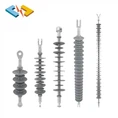

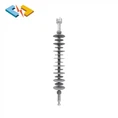


15kV Suspension Polymer Insulator with Socket & Ball
Products Description
Weathersheds & Housing
In a significant step forward for power transmission technology, our engineering team has successfully developed a newly optimized silicone rubber formulation after multiple rounds of research and testing. This advanced material represents a major improvement over conventional silicone rubber used in composite insulators.
Through continuous refinement and precise material compounding, the newly developed silicone rubber demonstrates superior adhesion to the fiberglass core rod. This enhanced bonding capability not only improves the mechanical integrity of the insulator but also ensures a more reliable interface between the housing and the core.
One of the key advantages of this innovation lies in its impact on electrical performance. By strengthening the adhesion between the silicone housing and the core rod, the risk of internal defects such as air gaps or delamination is significantly reduced. As a result, the insulator exhibits improved resistance to electrical stress, better long-term insulation reliability, and enhanced overall performance under harsh environmental conditions.
Compared with standard silicone rubber materials, this upgraded formulation offers greater stability, durability, and consistency in production. It also contributes to extending the service life of composite insulators, making it particularly suitable for high-voltage transmission systems and demanding outdoor applications.
This development reflects our ongoing commitment to innovation, quality, and performance in the field of composite insulation technology. As global demand for reliable and efficient power infrastructure continues to grow, we remain dedicated to providing advanced solutions that meet the evolving needs of the energy sector.
team introduction

socket & Ball
Features:
Multi-directional rotation (high flexibility)
Automatic adjustment to angle deviation (prevents uneven stress)
Easy installation/disassembly (high standardization)
Applications: Suspension string
Transmission lines (especially 110kV and above)
Basically conforms to international standards (IEC/ANSI) and is the mainstream configuration
Advantages:
High safety (with locking pins)
Uneven stress distribution
Suitable for long strings and multi-piece connections
Disadvantages: Slightly higher cost
Requires high processing precision
Clevis & Tongue
Features
Simple structure
Rigid connection (limited rotational capacity)
Applications
Tension insulators (dead-end)
Power distribution lines (medium and low voltage)
Column or short string structure
Advantages
Low cost
Robust structure
Easy to manufacture
Disadvantages
Poor rotational flexibility
Prone to eccentric stress
Unsuitable for long strings

The Drawing
35kV 70kN Composite Insulator


Application
1️⃣ Dead-end Structure
For 35kV lines:
Line start/end point
Substation incoming/outgoing lines
Used to secure the conductor and bear all tension.
2️⃣ Angle Tower/Angle Pole
When the line turns (e.g., 15°, 30°, 60°, etc.):
The conductor experiences lateral tension.
Tension insulators are required to withstand the unbalanced tension.
3️⃣ Long Span
Crossing:
Highways
Rivers
Valleys
Railways
Large spans and high mechanical loads require tension-resistant structures.
4️⃣ Mountainous or Windy Areas
In:
High-altitude areas
Typhoon-prone areas
Ice-covered areas
Tension insulators can withstand higher mechanical loads (70kN/100kN/120kN, etc.).
⚡ Typical Applications in 35kV Systems
35kV Overhead Transmission Lines
35kV Distribution Trunk Lines
Outgoing Lines from Small Substations
Wind/Hydropower Connection Lines
Hot Tags
33kV Dead-end insulator, 35kV Dead-end insulator, 34.5kV dead end insulator ,polymer insulator, Line Insulator, Silicone rubber insulator , high voltage insulator, suspension insulator ,
Hot Tags: 15kv suspension polymer insulator with socket & ball, China, manufacturers, suppliers, factory, wholesale, for sale, Composite Tension Insulator, 220V Composite Long Rod Insulator, Composite polymer insulator, 66kV Composite Long Rod Insulator, Silicone rubber Long rod insulator, Silicone rubber insulator


