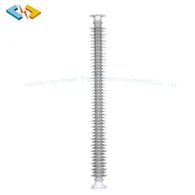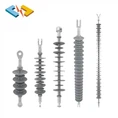

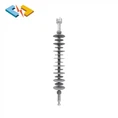

69kV Vertical Line Post Composite Insulator
Vertical Insulator
Our factory & quipments


Line post insulators are available with four types of line end fittings: Horizontal Clamp-Top, Vertical Clamp-Top, Tie-Top, and K-Clamp. The end fittings are manufactured from corrosion-resistant aluminum alloy or hot-dip galvanized ductile iron castings.
Vertical Line Post (also known as composite pin/vertical post insulator) is a vertically mounted insulator on the crossarm of a distribution pole. It serves two core functions: mechanical support and electrical isolation. It is an irreplaceable component in 10–110kV distribution networks, and its advantages can be explained from five aspects: structural rigidity, electrical performance, environmental adaptability, engineering cost, and advantages over porcelain/glass insulators.
1.Structural Installation Rigidity: A vertical rigid support is mandatory; suspension strings are not acceptable.
Compact Layout Requirements of Distribution Poles:In urban and rural distribution networks, single poles, narrow corridors, roadsides, and residential areas with limited space make it impossible to suspend a long string of suspension insulators. The Vertical Line Post is a single rigid post, vertically fixed to the crossarm, with the conductor directly clamped at the top. It has a compact structure, occupies minimal lateral space, and does not require additional crossarm lengthening. Bearing cantilever bending loads (core mechanical function): The conductor's own weight, wind pressure, icing, and line bends generate lateral bending moments. Vertical poles rely on the bending strength of the fiberglass core rod to stably support the conductor; suspension strings can only withstand tensile forces and cannot provide unilateral rigid support.
Replacing traditional porcelain pins and crossarms: Traditional porcelain pins are bulky and easily broken; composite vertical poles are integrally molded, offering stronger bending and impact resistance. In many scenarios, the entire porcelain crossarm can be eliminated, simplifying the pole structure and reducing steel usage.
Installation scenarios limited to vertical supports: Straight poles, small-angle poles, branch poles, transformer platforms, drop-out fuse supports; urban cable pole mounting, compact distribution network upgrades; railway traction, overhead lines within factory areas.
These locations lack suspension space and must be vertically installed with insulated supports to support the conductor.
2.. Essential Electrical Insulation Requirements: Isolating Live Conductors from Grounding Towers
Foundation insulation blocks leakage current.
Fiberglass epoxy resin core rods isolate high-voltage conductors from metal crossarms/grounding poles, preventing short circuits to ground, electric shocks, and line tripping.
Silicone rubber skirts provide ample creepage distance.
For polluted, humid, and foggy conditions, they lengthen the leakage path and suppress surface creepage; compared to ceramic insulators, composite materials increase flashover voltage by 30%~50%. Composite vertical poles must be used in heavily polluted areas (coastal salt spray, industrial dust, mining areas) to significantly reduce flashover outages.
Hydrophobic and self-cleaning, inhibiting continuous water film.
3.HTV high-temperature vulcanized silicone rubber has durable hydrophobic properties, preventing the formation of a continuous conductive water film in rainy weather. Leakage current is far lower than that of porcelain insulators, reducing the risk of lightning strikes and fog flashovers, and decreasing the number of line faults. III. Irreplaceable in Harsh Environments (Porcelain/Glass Cannot Do This)
Coastal Areas, Saline-Alkali Areas, Chemically Polluted Areas: Porcelain insulators require regular manual cleaning after accumulating dirt, resulting in extremely high maintenance costs. Composite vertical posts are hydrophobic and self-cleaning, requiring no cleaning year-round. Their aging rate under coastal salt spray corrosion is far slower than that of porcelain enamel.
High-Altitude, Icy, and Strong UV Areas:Silicone rubber is resistant to high and low temperatures and UV cracking. Fiberglass core rods have good elasticity and are not easily brittle during freezing and freeze-thaw cycles. Porcelain components are extremely prone to cracking and explosion due to low-temperature thermal shock.
Mountainous Areas, Construction Sites, Areas Prone to External Impacts: Composite materials have high toughness and will not shatter upon impact with vehicles, gravel, or during construction. Porcelain insulator fragments after impact can easily cause grounding short circuits, injuries, and significant safety hazards.
Mountainous Areas, Construction Sites, Areas Prone to External Impacts:Composite materials have high toughness and will not shatter upon impact with vehicles, gravel, or during construction.
4. Economic Advantages in Engineering and Operation & Maintenance, A Top Priority for Engineering Projects
Extremely Lightweight, Reducing Tower Load
Weighing only 1/10 of porcelain poles for the same voltage level, existing old cement poles and thin steel crossarms do not require reinforcement or modification and can be directly replaced, significantly reducing tower upgrade costs; transportation and hoisting labor costs in mountainous and remote areas are greatly reduced.
Significantly Reduced Operation & Maintenance Costs
No need for annual power outages for cleaning; Less prone to damage, replacement cycle over 30 years; Almost eliminates accidents such as broken wires falling and porcelain short circuits, reducing losses from power outages during repairs.
Simple Construction, Shortened Construction Period
Single-unit integrated structure, pre-assembled hardware, only bolt fixing is required on-site. Compared to multi-piece porcelain pin assembly and suspension hoisting, construction efficiency is more than doubled.
The drawing

comparison of product parameters
| Applications | Transmission | Material | HTV Silicone Rubber |
| Size | 676 ±15mm | Standard | IEC or ANSI |
| Type | Transmission Line Post Insulators | Voltage | 69kV |
| Min Arcing Distance | 517mm | Creepage Distance | 1453mm |
| Diameter of Rod | 55mm | Number of sheds | 11 |
| Specified Cantilever Load | 9.5kN | Maximum Design Cantilever Load | 6.2kN |
| Low Frequency Flashover Voltage Dry | 225kV | Low Frequency Flashover Voltage Wet | 175kV |
| Critical Impulse Flashover Voltage Positive | 335kV | Critical Impulse Flashover Voltage Negative | 515kV |
| Color | Grey | Weight | 9.8kg |
Hot Tags
69kV Vertical Line Post Insulator, 69kV Line Post Insulator, Vertical Line Post Insulator, Composite Line Post Insulator, Polymer Line Post Insulator, Silicone Rubber Line Post Insulator, 69kV Polymer Insulator, 69kV Composite Insulator, 69kV Outdoor Insulator, 69kV Station Post Insulator
69kV Vertical Composite Line Post Insulator, 69kV Polymer Line Post Insulator Manufacturer,
Hot Tags: 69kv vertical line post composite insulator, China, manufacturers, suppliers, factory, wholesale, for sale, 138kV Composite Station Post Insulator, 220kV station post insulator, 330kV station post insulator, 69kV Composite Station Post Insulator, Polymer Station Post Insulators