





110kV Composite Interphase Spacer
Products Description

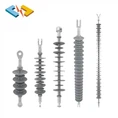
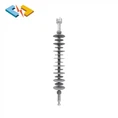
Structure
Core Rod: Epoxy fiberglass pultruded rod (bears tensile and bending loads)
Sheath Skirt: High-temperature vulcanized silicone rubber (HTV), aerodynamic umbrella shape, hydrophobic and anti-fouling
Ends: Crimped metal fittings; high-voltage level matching equalizing rings
Connection Types at Both Ends: B. Ball-and-socket type / C. Slot type / W. Universal joint / H. Ring type
Core Functions
1. Conductor anti-galloping (primary application): Connects different phase conductors within a span, mechanically coupling the phase conductors, mutually restraining them, suppressing low-frequency large-amplitude galloping under icing and strong winds, preventing phase-to-phase short circuit tripping.
2. Locking phase-to-phase safe distance: Commonly used in compact lines, compressing the line corridor, avoiding conductor proximity and phase-to-phase flashover caused by icing and sag changes.
3. Possesses dual properties of insulation and mechanical load bearing; essentially a long rod-shaped composite insulator, used as a phase-to-phase mechanical limiting component.
Product Features
- Excellent hydrophobicity of silicone rubber, eliminating the need for cleaning in heavily polluted areas and requiring no zero-value testing.
- Significantly lighter than ceramic interphase spacers, simplifying transportation and installation.
- Resistant to aging, ozone, and impact; not easily broken; can withstand high-flexure bending fatigue (500,000 bending vibrations).
- Suitable for single-conductor and split-conductor circuits
The Function


1. Core Function of Phase-to-Phase Spacer Bars (Single/Double Split)
They are installed between different phases (A-B, B-C, A-C), not within the same phase:
1). Mechanical constraint to prevent galloping and ice breakage: Mechanically connecting two phase conductors, when one phase swings significantly, it is restrained by the other, limiting the amplitude of the galloping and preventing the phase-to-phase distance from narrowing;
2). Electrical insulation: The core bar + silicone rubber sheds provide phase-to-phase insulation, ensuring that the two phases will not short-circuit through the spacer bar during normal operation;
3). Maintaining the minimum phase-to-phase air gap to prevent phase-to-phase flashover tripping.
Ordinary split spacer bars are installed within the same phase to fix 2/4 sub-conductors within a phase. Do not confuse them.
2. Why can both single-conductor and double-conductor lines be adapted?
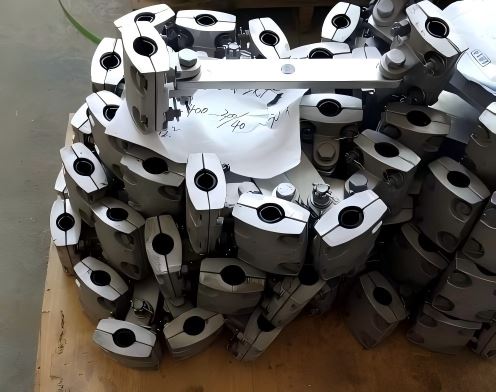
Single-conductor lines (such as many 110kV single-conductor lines): Each phase has only 1 conductor → Single-line clamps are attached to both ends of the spacer bar to directly clamp that single conductor of each phase.
Double conductor = Double-split conductor (commonly used in 220kV, one phase contains 2 sub-conductors: one phase consists of two parallel sub-conductors, first fixed together as a whole using in-phase split spacers; then one end of the interphase spacer is fixed to this double-split whole (with double-connecting plates/double clamps), treating the entire phase as a unit to establish cross-phase constraint with the other phase.
The insulation, bending resistance, and pressure bearing performance of the main composite insulation rod itself remain unchanged; only the end fittings are modified to adapt to whether one phase has a single or two sub-conductors.
3. Mechanical Logic (Why can both configurations achieve mutual constraint?) Galloping is the overall low-frequency, large-amplitude motion of the entire phase conductor, not the movement of a single sub-conductor:
Single conductor: The mass and stiffness of the entire phase are that single conductor;
Double-split: The two sub-conductors are locked together by in-phase split spacers, moving synchronously, equivalent to a single overall mass unit;
The interphase spacer connects the two phases as an overall unit, so regardless of whether the unit is 1 or 2... Both the root wires can achieve mutual restraint and suppression of two-phase motion.
The Drawing


The technical requirements:
1.Creepage distance:8340mm
2.SML:70kN.
3.Rated Voltage:110kV
Lightning Impulse withstand voltage:650kV.
Power frequency withstand voltage wet one minute:325kV
4. The coupling: The conductor
5. Color:Grey
Hot Tips
Interphase Spacer, Composite Interphase Spacer, Polymer Interphase Spacer, Interphase Spacer Insulator, Composite Interphase Spacer Insulator, Polymer Interphase Spacer Insulator ,Overhead Line Interphase Spacer, Transmission Line Interphase Spacer, Interphase Spacer for Overhead Lines, Interphase Spacer for Transmission Lines, HV Interphase Spacer, High Voltage Interphase Spacer
Hot Tags: 110kv composite interphase spacer, China, manufacturers, suppliers, factory, wholesale, for sale, 15kV Composite Fuse Cut Body, 27kV Composite Fuse Cut Body, 38kV Composite Fuse Cut Body, Composite Insulator Rubber, Polymer stay insulator for guy wire, Spare Parts For Composite Insulators


