


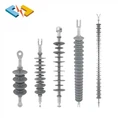

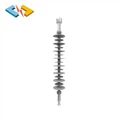
Recently, a conference on insulators for substations was held in the ancient city of Dunhuang. The reason why this remote desert oasis became the venue of the meeting was because of an unusual 750kV test substation nearby, namely the Shazhou Substation. What makes Shazhou Substation so unique is out of it is the first substations in which all equipment in the station is insulated with composite jackets, from bushings to arresters, from transformers to substation pillars and so on.
A wide range of topics were discussed at the meeting. For example, Professor Liang Xidong of Tsinghua University reported that the application of composite insulators in China has helped greatly reduce flashover accidents since the 1990s. Song Shengli of the State Grid Corporation also proposed that, given the typical harsh environment in many areas of China, DC porcelain insulators usually require a uniform creepage distance (USCD) as high as 86mm/kV. He proposed that if a composite jacket is used instead of porcelain insulators, less than 50mm/kV is sufficient in the above-mentioned applications. He also emphasized the specific problems that need to be solved with this technology, such as gas leakage of SF6 casing, ice and snow flashover, and mechanical stress of UHV equipment. Fang Jiang, an expert on domestic composite insulator manufacturers, organized the meeting. He reviewed the research carried out by the Key Laboratory of Composite Materials and Components of the China Electric Power Research Institute, with the goal of optimizing the jacket design. He also summarized the technology to reduce the risk of bird damage or rodent damage to insulators, and so far, there have been no serious incidents of pecking or biting among the 300,000 composite insulators produced by this factory.
Ravi Gorur of Arizona State University also pointed out at the meeting that, unlike China, the obvious trend that urges the United States to adopt a large number of composite jackets is not because of its excellent stain resistance, but from the perspective of its safety and cost benefits. . According to Gorur, U.S. power companies are now even more accepting of composite jackets than line insulators. Stanislaw Gubanski from Sweden also pointed out that it is necessary to ensure that composite insulators not only perform well in polluted environments, but also in other operating environments. For example, it has been reported that microorganisms grow on this kind of jacket in tropical and humid areas, but because it does not cause degradation of silicone rubber materials and usually has limited impact on electrical properties, it is not regarded as a serious threat.
Luo Bing introduced some research carried out by China Southern Power Grid, and reported on the DC operation experience. At present, it is almost common practice to use composite jackets in domestic substations. He also pointed out that because composite post insulators have more advantages than porcelain insulators, they are now increasingly used. Based on 6 years of operating experience, more than 1,000 composite post insulators installed in UHV/UHV DC have performed well. He did mention some of the aging problems of composite outer sleeves made of liquid silicone rubber (LSR), including local hardening, cracking and loss of hydrophobicity. Pollution flashovers and rain flashovers also occurred in a small number of jackets with too small distance between umbrella skirts. However, based on experience, the pollution test is usually more stringent, so a properly designed anti-fouling insulator should be considered to have sufficient performance to operate well under heavy rain. He suggested that, based on this, the DC insulator umbrella pitch/overhanging distance (S/P) ratio>0.9, the minimum distance between large umbrella skirts must be at least 70mm, and the best distance is 90mm.
Zhou Jun of the China Electric Power Research Institute also reported on their research work, including long-term testing of composite jackets produced by different manufacturers in high-altitude areas in Tibet. He pointed out that China has issued many new standards for composite insulators that are ahead of the IEC. Denis Chattrefou of Alstom mentioned that, among other things, it is necessary to integrate optical fiber into a composite post insulator that is an essential part of non-traditional digital sensors.
Finally, Zhu Anming of State Grid of China and Yu Bo from CPECC jointly reviewed the various technical and economic basis for the use of composite pillar insulators and jackets in the entire Shazhou substation. First, these jackets must pass rigorous tests that simulate the harsh desert operating environment of the substation. The subsequent comparison of economic calculations shows that this is a better solution considering the total cost of procurement and life cycle.
Then I visited the 750 kV Sazhou test substation that has been in operation since 2013, allowing the speakers and other guests to appreciate its unique characteristics and the harsh conditions of the site. This meeting helped to clearly understand the current state of composite jackets and convinced me that this currently mature product technology is becoming more and more competitive.