


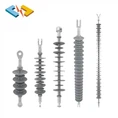

Composite Station Posts (CSP): Solid Core Type
CSPs, which were first introduced during the early 1980s, are comprised of a solid core fiber-reinforced polymeric (FRP) core and an elastomeric housing. The typical diameter of the FRP core ranges from 45 to 100 mm, with maximum diameters rarely exceeding 130 mm. The application of CSPs in substations stemmed from previous use of composite line post (CLP) insulators, primarily in the United States. CSPs with solid cores are typically employed in voltages up to 245 (420) kV. However, for higher voltage classes, their broader application is limited due to relatively high mechanical deflection. The test standard for this product is IEC 62231, while mechanical and electrical characteristics are defined in IEC 62231-1, which also includes ANSI types utilized in North America. The relevant standard for such ANSI types is C29.19.
Composite Station Posts: Hollow Core Type (CHSP)
At voltage classes higher than 245 kV, the height and bending moment of station posts both increase. Consequently, meeting application requirements using solid core CSP designs (i.e., with core diameters >170 mm) demands significant effort. This renders this technology less cost-competitive compared to porcelain types. Simultaneously, composite hollow core station posts (CHSP) and hybrid station post (HSP) insulators have started to emerge in this application portfolio. For instance, CHSPs have already been implemented in 800 kV HVDC and 1100 kV UHV applications, featuring connection lengths of over 10 m and tube diameters ranging from 500 to 1000 mm. Bending moments exceeding 1000 kNm are achievable with this technology. The hollow volume inside these posts must be filled with an electrically inert medium such as insulating gas foam. The applicable test standard for these is IEC 62772.