


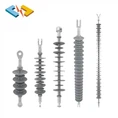

With the development of the power industry, the continuous expansion of transmission capacity, and the increasing voltage levels of transmission lines and substations, the requirements for insulators in power systems are becoming more stringent. Traditional porcelain or glass insulators, which have been in use for over 100 years in high-voltage transmission lines, have both advantages and disadvantages. These include being heavy and fragile, having low pollution resistance, and being prone to internal insulation breakdown. Therefore, there is an urgent need for a new type of insulator to replace traditional porcelain insulators. With the rapid development of the chemical industry and the emergence of new composite materials, a new generation of insulators made primarily from organic materials-composite insulators-has emerged.
Composite insulators are an excellent choice for easy installation or for use in areas with high levels of contamination. They are composed of a composite structure made from two or more types of organic materials. The composite insulators used in power grids are primarily rod-shaped suspension insulators.

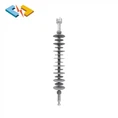
The main structure of the insulator is shown in the diagram below:

1. End Fittings : End fittings are the metallic parts of the composite insulator, serving as the mechanical load transmission components. They connect the insulator to the tower and conductors, and their quality directly impacts the mechanical strength and performance of the composite insulator.
2. Core Rod : The core rod, also known as a pultruded glass fiber reinforced epoxy rod, is the primary load-bearing part of the composite insulator and the main component of internal insulation. It must possess high mechanical strength, excellent insulation properties, and long-term stability. The core rod material is typically a resin-reinforced unidirectional glass fiber pultruded rod. It acts as the backbone of the composite insulator, supporting the sheds, providing internal insulation, connecting the end fittings, and bearing mechanical loads. With a tensile strength generally exceeding 600 MPa, the core rod is twice as strong as ordinary steel and 5-8 times stronger than porcelain. Additionally, it has good dielectric properties, chemical resistance, bending fatigue resistance, creep resistance, and impact resistance.
3. Sheds (Housing) : The sheds or housing form the external insulation part of the composite insulator. Their role is to provide high resistance against wet and contaminated flashovers, protecting the core rod from atmospheric exposure. The sheds are exposed to outdoor conditions, enduring harsh weather and industrial pollution, and may suffer from spark discharges or partial arc erosion during operation. Therefore, the sheds must have excellent anti-contamination flashover resistance, tracking and erosion resistance, as well as resistance to ozone, high temperatures, and atmospheric aging.
Additional Component
Adhesive Layer : The adhesive layer is the interface between the core rod and the housing, extending between the two end fittings. It is another critical part of the internal insulation of the composite insulator. Poor adhesive quality can become a weak point in the insulator's operation.
These components collectively ensure the composite insulator's superior electrical insulation performance, mechanical strength, and durability, making it a suitable replacement for traditional porcelain insulators, especially in high-voltage and polluted environments.