


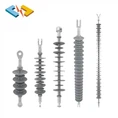

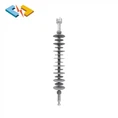
In recent years, researchers have been trying to determine just how harmful biological contamination is to insulators, focusing on the electrical properties of non-porcelain insulators when they are exposed to contamination.

This is because organic particles in the air can be scattered everywhere, and these particles provide the necessary nutrients for the filth to grow. Non-porcelain insulator skirts are the most likely to suffer from biological contamination.
In Sweden, researchers are looking at the filth problem from several angles. One is to develop new diagnostic instruments for identifying and assessing the dangers of growth. Other groups want to find better materials for skirts to inhibit the growth of microorganisms, and they are also studying how insulators degrade when contaminated with organic waste. For example, the addition of a flame retardant to silicone rubber insulators was found to successfully inhibit the growth of fungi.
At present, most of the articles on the biological pollution of porcelain insulators refer to the external environment in the tropical region, that is, the environment with heavy rainfall, high humidity, high temperature and strong sunshine. Such external environmental conditions can affect biological pollution in many ways. For example, high humidity and high temperature are conducive to microbial growth; Heavy rainfall and sunshine inhibited microbial growth.
To sum up, an important conclusion can be drawn from the present observations: the growth of biological contaminants does not produce significant physical or chemical changes on the surface of porcelain insulators. In fact, these biological filth can be easily cleaned with water. Data show that the electrical performance of dirty insulators will be greatly reduced, and the wet lightning voltage is only 70% of the normal value.
At present, the research on non-porcelain insulator is not as clear as that on porcelain insulator. Many articles have been written on the performance of non-porcelain insulators subjected to biological contamination, some of which have been conducted in the tropics, some in the subtropical and temperate regions. Insulators made of silicone rubber, epoxy resin or a mixture of silicon and EPDM have been found to support the growth of bacteria, algae, fungi, moss and moss. There is no more report on the research of insulator made of EPDM.
Biological pollution of non-porcelain insulators mainly occurs in highly humid environments, and may also occur in relatively clean conditions. Biological pollution can make the waterproof performance of the invaded parts of the insulator surface worse, so the wet lightning pressure becomes lower. Although the reduction of wet lightning pressure after contamination of non-porcelain insulators is not obvious compared with that of porcelain insulators, this is mainly because the biological pollution on the surface of insulators is usually distributed in an island pattern, and the clean parts that are not polluted still maintain strong hydrophobicity, so they can still maintain good flashover performance.
The difference between non-porcelain insulators and porcelain insulators is that most non-porcelain insulators contain organic matter inside, which can eventually be digested and absorbed by microorganisms and become their nutrients. However, silicone rubber is special because it can inhibit biodegradation. The research found that the main reason is that silicone rubber contains both organic and inorganic substances.
The tiny organic matter in the umbrella skirt provides nutrients for microbial growth, and these microorganisms form a membrane on the insulator surface mixed with a variety of biological communities, including bacteria, fungi, protozoa, algae and so on. They will cause changes in the function and structure of the polymer insulator, and the most serious harm is that they penetrate into the skirt, leading to significant changes in the characteristics of the insulator.
Studies have shown that silicone rubber insulators can maintain high stability when subjected to biological filth, and there is no obvious evidence to prove the existence of biodegradation of silicone rubber insulators. Although many components of the insulator are likely to be degraded, the growth of biological filth does not cause significant degradation of the silicone rubber biofilm.
Summarizing the research results of Swedish scholars and other relevant research institutions in the world, we can know that, on the whole, biological pollution has little influence on the electrical properties of non-porcelain insulators. The biofilm on the insulator contains water, which will cause the leakage current to rise under wet conditions, but the current rise will not be very obvious because of the low electrical conductivity of the biofilm.