


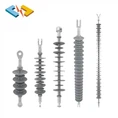

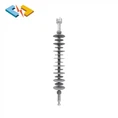

Insulators can be classified based on different installation methods into suspension insulators and post insulators. According to the insulating materials used, they can be divided into porcelain insulators, glass insulators, and composite insulators (also known as synthetic insulators). Based on the voltage level, they can be categorized into low-voltage insulators and high-voltage insulators. Insulators designed for specific environmental conditions, such as pollution-resistant insulators for polluted areas, also exist. According to the type of voltage used, there are DC insulators. Additionally, there are various insulators for special purposes, such as insulating crossarms, semiconductor glaze insulators, strain insulators for distribution, spool insulators, and wiring insulators.
Furthermore, based on the likelihood of the insulating element breaking down, insulators can be classified into two types: Type A, which is non-puncturable, and Type B, which is puncturable.
Suspension Insulators Widely used in high-voltage overhead transmission lines and in the insulation and mechanical fixation of flexible busbars in power plants and substations. Suspension insulators can be further divided into disc suspension insulators and rod suspension insulators. Disc suspension insulators are the most commonly used type in transmission lines, while rod suspension insulators are extensively used in countries like Germany.
Post Insulators Primarily used for the insulation and mechanical fixation of busbars and electrical equipment in power plants and substations. Additionally, post insulators are often part of electrical devices such as disconnectors and circuit breakers. Post insulators can be categorized into pin-type post insulators and rod-type post insulators. Pin-type post insulators are mainly used in low-voltage distribution lines and communication lines, while rod-type post insulators are commonly used in high-voltage substations.
Porcelain Insulators Insulators whose insulating element is made of electrical porcelain. Electrical porcelain is made by firing a mixture of quartz, feldspar, and clay. The surface of porcelain insulators is usually coated with a ceramic glaze to improve mechanical strength, water resistance, and surface smoothness. Among various types of insulators, porcelain insulators are the most widely used.
Glass Insulators Insulators with insulating elements made of tempered glass. The surface is in a state of compressive pre-stress, and if cracks or electrical breakdowns occur, glass insulators will self-shatter into small pieces, a phenomenon known as "self-destruction." This characteristic eliminates the need for "zero-value" detection during operation.
Composite Insulators Also known as synthetic insulators. The insulating element is made of a fiberglass resin rod (or tube) and an organic material sheath and skirts. Features include small size, light weight, high tensile strength, and excellent pollution flashover resistance, though they are less resistant to aging compared to porcelain and glass insulators. Composite insulators include rod suspension insulators, insulating crossarms, post insulators, and hollow insulators (composite bushings). Composite bushings can replace porcelain bushings used in various power equipment, such as transformers, surge arresters, circuit breakers, capacitive bushings, and cable terminations. Compared to porcelain bushings, they offer advantages such as higher mechanical strength, lighter weight, and smaller dimensional tolerances, and they avoid damage caused by explosive shattering.
Low-Voltage and High-Voltage Insulators Low-voltage insulators are used in low-voltage distribution and communication lines. High-voltage insulators are used in high-voltage and extra-high-voltage overhead transmission lines and substations. To meet the needs of different voltage levels, insulator strings or multi-section insulator posts are usually formed by combining multiple identical insulators.
Pollution-Resistant Insulators Mainly involve increasing or enlarging the skirts or sheds of insulators to increase creepage distance and enhance electrical strength under polluted conditions. Structural shape changes to the skirts are also made to reduce natural surface pollution and improve pollution flashover resistance. Pollution-resistant insulators generally have a creepage distance 20% to 30% longer than that of ordinary insulators, sometimes even more. In areas of China with frequent pollution flashovers, double-skirted pollution-resistant insulators with strong self-cleaning capabilities are commonly used, which are also easy to clean manually.
DC Insulators Mainly refers to disc insulators used in DC transmission. DC insulators generally have a longer creepage distance than AC pollution-resistant insulators, with insulating elements having higher volume resistivity (not less than 10 Ω·m at 50°C), and connecting hardware fitted with sacrificial anodes (such as zinc sleeves or zinc rings) to prevent electrolytic corrosion.
Type A and Type B Insulators Type A (non-puncturable) insulators have a dry flashover distance not exceeding three times the dry breakdown distance (for cast resin types) or twice (for other materials). Type B (puncturable) insulators have a breakdown distance less than one-third (for cast resin types) or one-half (for other materials) of the dry flashover distance. The dry flashover distance is the shortest distance through the air along the surface of the insulating element, while the breakdown distance is the shortest distance through the insulating material of the insulating element.