


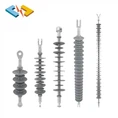

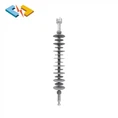

Composite insulators are critical components for HV transmission lines, designed to perform effectively in various pollution environments. They are known for their lightweight, compact structure, resistance to breakage, high tensile strength, and excellent pollution resistance.
Product overview
These insulators are extensively used in high-voltage transmission lines and are adaptable to different pollution levels. They are characterized by their lightweight, compact design, breakage resistance, high tensile strength, and strong pollution resistance.
They are constructed from at least two insulating parts: a core rod and an outer sheath with metal fittings. Polymer insulators are made from polymer-based materials. It can be assembled by attaching individual sheds to the core, with or without an intermediate sheath, or by molding or injecting the outer sheath directly onto the core. The core of the composite insulator provides the mechanical strength, typically made from fibers embedded in a resin matrix or a uniform insulating material. Insulators made from two polymer materials are termed composite insulators.
Main models
FXBW-10/70, FXBW-15/70, FXBW-24/70, FXBW-33/70, FXBW-35/70, FXBW-35/100, FXBW-36/100, FXBW-66/100, FXBW-110/100, FXBW-100/100-D, FXBW-132/120, FXBW-132/160, FXBW-220/100, FXBW-220/160, FXBW-220/160, FXBW-330/100, etc.
Applications
Wuhan Line Power specializes in organic composite insulators manufacturers. Their main products include rod-shaped suspension composite insulators ranging from 10kV to 1000kV, ±800kV DC rod-shaped suspension composite insulators, pin composite insulators, crossarm composite insulators, pillar composite insulators, electrified railway composite insulators, composite bushings, and composite arresters. The quality of these products meets the International Electrotechnical Commission IEC61109 and GB/T19519 standards, achieving both domestic and international excellence.
Structure and performance
Silicone composite insulators consist of a shed, a core rod, and metal fittings at both ends. Products with a voltage of 110kV and below do not include a grading ring. For products with a voltage of 220kV and above, 1 to 2 grading rings are provided. Grading rings can also be added based on user requirements.
1. Shed: Made from high polymer silicone rubber, the shed offers excellent hydrophobicity, corrosion resistance, and aging resistance, preventing flashover accidents, reducing manual cleaning, and eliminating zero-value maintenance, thereby ensuring the safe operation of transmission lines.
2. Core Rod: Composed of fiberglass-reinforced resin rods, the core rod boasts a high tensile strength (>1100Mpa), approximately 1.5 to 2 times that of ordinary steel and 3 to 5 times that of high-strength porcelain. It also features good vibration resistance, creep resistance, and fatigue fracture resistance.
3. Metal Fittings: The silicone rubber insulators metal fittings are connected to the core rod using a non-damaging mechanical crimping method, which is the most advanced connection technique internationally. This method ensures a safe and reliable connection, uniform stress distribution, and maintains the integrity of the fiberglass bundle, maximizing its high tensile strength.
4. Grading Ring: The grading ring improves electric field distribution, reduces corona and radio interference, and protects the shed from being burned by strong arcs, especially in high-voltage composite insulators.
5. Compact Structure: These insulators have a compact design, are lightweight (1/7 to 1/10 of the same-level porcelain insulator string), and exhibit good elasticity, eliminating the need for periodic cleaning. This design simplifies transportation and installation, reduces maintenance workload and costs, lowers labor intensity, and provides excellent conditions for accident repairs and the implementation of compact lines.
6. Production Process: Composite insulators are manufactured using an integral injection molding process. The sheds are aesthetically pleasing, have minimal interfaces, and the core rod and sheath are firmly bonded without gaps, ensuring superior internal insulation performance and preventing interface breakdown.