


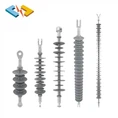

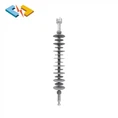

Insulators are special insulation components in overhead transmission lines and play an important role.
What are 5 types of insulators?
1. Suspension insulator
2. Line Post insulator
3. Pin insulator
4. Tension insulator
5. Cross-arm insulator
Insulators are objects used to fix or suspend conductors for electrical insulation mounted on poles or towers.
The number of insulator sheds can indicate the voltage level. Typically, for 500 kV it is 23 pieces; for 330 kV, it is 16 pieces; for 220 kV, it is 9 pieces; and for 110 kV, it is 5 pieces. These are the minimum numbers, and in practice, there may be one or two more.
Especially, composite insulators, as one of the most popular products, have the advantages of light weight, small size, high resistance to flashover, aging resistance, and being maintenance-free. These advantages have led to their widespread use in power transmission lines.

Suspension insulator
Suspension insulators are widely used in high-voltage transmission lines. They can withstand greater mechanical stress and electrical loads.
A single suspension insulator is usually used for a specific voltage, while multiple insulators can be connected in series to form an insulator string, making them suitable for higher voltage applications. Due to this design, suspension insulators can be used for 33 kV to 800 kV or even higher voltages. They are usually made of porcelain, toughened glass, or composite materials. Composite insulators are becoming more popular because they are lighter in weight and have better pollution resistance.
Besides, suspension insulators can withstand mechanical stress (for example, strong winds or heavy conductor loads) with greater flexibility, making them the first choice for long-distance and high-voltage transmission lines.
Line Post insulator

Line post insulators are used for medium-voltage overhead power lines, typically ranging from 11kV to 132kV. Unlike other types of insulators, line post insulators are fixedly mounted on poles or crossarms to provide both mechanical support and electrical insulation for conductors.
These insulators are designed to withstand both vertical and horizontal loads, making them suitable for straight sections, angle supports, and terminal poles. They are usually made of ceramic or composite materials, ensuring durability and reliable performance in various environmental conditions.
Pin insulator

Pin insulators are designed for medium-voltage power lines, typically handling voltages up to 33kV. They consist of a single-piece or multi-piece structure, mounted on a pin fixed to crossarms or poles. The top groove holds the conductor securely with binding wire, ensuring stable electrical performance. Made from high-strength porcelain, glass, or composite materials, pin insulators offer excellent mechanical strength and weather resistance. Their ability to withstand electrical and mechanical stresses makes them ideal for rural and urban distribution networks, minimizing the risk of flashover and ensuring reliable insulation.
Tension insulator

Tension insulators are key part in power transmission lines, used to support conductors at the start, end, and turning points of a line, where mechanical tension is highest. These insulators are designed to withstand the forces exerted by the tension in the wire while providing electrical insulation. Typically suspended horizontally, tension insulators must meet high mechanical strength requirements. Made from durable materials like composite polymers, they offer excellent resistance to aging, pollution, and environmental stress, ensuring long-lasting performance and reducing maintenance needs in challenging conditions.