


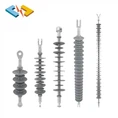

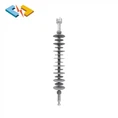

What is an Insulator?
An insulator is a device installed between conductors at different potentials or between conductors and grounding components. It is designed to withstand voltage and mechanical stress.
Insulators come in various types and shapes and consist of two main parts: insulation and end fittings. The insulation plays a crucial role in overhead transmission lines.
In the early years, insulators were mainly used on poles. Today, they have evolved to connect one end to the tower and the other to high-voltage wires, increasing creepage distance. Insulators are typically made of silicone rubber, glass, or ceramic.

Requirement and function for insulator
Under the specified operating voltage, lightning overvoltage, and internal overvoltage conditions, there shall be no punctures or surface flashovers. Under the specified long-term or short-term mechanical loads, no damage or breakage shall occur. After long-term operation under specified mechanical, electrical loads, and various environmental conditions, no significant degradation will occur. The insulator end fittings will not exhibit noticeable corona discharge phenomena under operating voltage.
Types of Insulators
Insulators can be classified in three ways: by installation method, material, and voltage level. By installation, they are divided into suspension insulators (used in overhead lines) and line post insulators (mounted on poles). By material, they include composite insulators (lightweight and pollution-resistant), glass insulators (durable and easy to inspect), and porcelain insulators (high strength and insulation). By voltage, they are categorized as low voltage insulators (for distribution networks) and high voltage insulators (for transmission lines). Each type is designed to meet specific operational needs.

Insulator Performance Requirements
Insulators must meet specific performance requirements to ensure reliable operation in power systems, including electrical performance to withstand maximum operating voltage and overvoltages, measured by dry flashover voltage, wet flashover voltage, and puncture voltage; mechanical performance to support the weight of conductors and equipment while enduring forces from wind, ice, and other environmental factors, characterized by tensile strength, bending strength, and torsional strength; and environmental performance to resist pollution, aging, and corrosion, ensuring stable functionality in harsh conditions over time.