


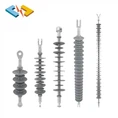

The raw materials used to make glass insulators are more stable than the raw materials used to make electric porcelain in terms of their composition, which creates good conditions for stabilizing the electrical and mechanical properties of glass.
Due to the transparency of the glass, it is easy to find small cracks and various internal defects and damages during the shape inspection.
The electromechanical performance of glass is much higher than that of porcelain, and the same type of insulator is manufactured, and its size and weight are much smaller than porcelain insulators.
For the insulator of the unit, the insulation resistance can only be measured in the case of power failure. The relevant regulations stipulate that a megohmmeter of 2500V and above is used. At present, 2500V and 5000V megohmmeters are used more, and there are special instruments with higher voltage. But in fact, within 1*104MΩ, 2500V and 5000V megohmmeters with the same accuracy, the insulation resistance measured under the same humidity is basically the same.
For multi-element insulators, the insulation resistance can be measured when power is cut off or charged. The method is to connect the high-resistance to the charged insulator, so that the megohmmeter for measuring the insulation resistance is at ground potential, and subtract the high-resistance resistance value from the measured insulation resistance, which is the insulation resistance value of the tested insulator.