


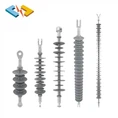

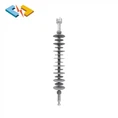
DS-15 DS-28 DS-35 Polymer Tension Insulator

Distribution Deadend Insulators – DS-M Series
The DS-M Series distribution deadend insulators are manufactured using a conventional silicone rubber housing, formed by injection molding and securely bonded to a high-strength fiberglass core. The voltage range covers 15 kV to 46 kV, and the standard end fitting configuration is Clevis-Tongue connection.
Applications:
These deadend insulators are designed to support conductors under tension or suspension conditions. They are typically installed with one end fixed to a pole, cross arm, or guy wire, ensuring reliable mechanical strength and electrical insulation performance.
DS-15 DS-28 DS-35
Customize the product according to the customer's requirements
Product drawing

Basic feature
| Item | Mechanical Load | Rated Voltage | Main difference |
| DS-15 | 70kN | 15kV | Short creepage distance |
| DS-28 | 70kN | 28kV | Medium creepage distance |
| DS-35 | 70kN | 35kV | Maximum creepage distance |

Applications:
10kV–15kV power distribution lines
Rural power grids
Urban low-voltage power distribution
Features:
Short creepage distance
Smaller structural size
Lower cost

Applications:
24kV / 27kV / 28kV systems
Lines below 33kV
Medium-voltage distribution networks
Features: Increased creepage distance
Larger insulation length

Applications:
35kV transmission/distribution lines
Industrial power grids
Main distribution networks
Features:
Longer creepage distance
Higher lightning impulse withstand voltage
Higher power frequency withstand voltage
Advantages of Composite Deadend Insulators
1. Improved System Reliability
Composite deadend insulators significantly improve the reliability of distribution and transmission lines. Their superior hydrophobic silicone rubber housing helps prevent flashover under contaminated or wet conditions. In addition, the polymer structure reduces the risk of failures caused by vandalism, pole fires, or environmental stresses, thereby minimizing power outages and improving system stability.
2. Reduced Maintenance Requirements
Compared with traditional porcelain or glass insulators, composite deadend insulators require little to no routine maintenance. The hydrophobic surface naturally resists contamination buildup, reducing the need for periodic cleaning or inspection. This greatly lowers maintenance costs and ensures compatibility with existing line hardware and structures.
3. Improved Power Quality
Composite insulators help maintain stable electrical performance by reducing leakage current and minimizing transient voltage losses. Their excellent insulation properties contribute to more consistent voltage levels along the distribution line, improving the overall quality of power delivery.
4. Higher Energy Efficiency
Due to the reduced leakage current and better insulation characteristics, power losses along the line are minimized. This results in improved energy efficiency and reduced operational losses for utilities.
5. Enhanced Safety
Composite deadend insulators are significantly lighter than porcelain insulators, making them easier and safer to transport, handle, and install. Their non-brittle design also reduces the risk of shattering, improving safety for installation crews and maintenance personnel.
6. Long Service Life
The high-quality silicone rubber housing and fiberglass core provide excellent resistance to UV radiation, moisture, and environmental aging. As a result, composite deadend insulators maintain stable mechanical and electrical performance throughout a long service life, even in harsh environments.
7. Lower Life-Cycle Cost
Although the initial purchase price may be comparable to conventional insulators, composite deadend insulators offer lower total life-cycle costs. Reduced maintenance, lower installation costs, improved reliability, and longer service life all contribute to significant cost savings over time compared with porcelain insulators.
Manufacturing Process Comparison
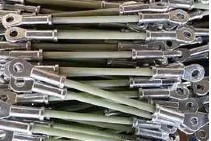
Different manufacturing processes result in different product performance and appearances. Many manufacturers currently employ a double-seal structure at the ends, effectively protecting the ends from moisture erosion and preventing brittle fracture of the mandrel. Due to the use of a high-temperature sheath at the ends, the resistance to electrolytic aging is significantly improved compared to room-temperature adhesives when corona discharge occurs.

high sealing performance
Composite insulators require extremely high sealing performance from their end fittings to ensure mechanical strength, electrical performance, and long-term reliability. Poor sealing allows moisture or contaminants to enter, leading to premature insulator failure. The main reasons can be understood from the following aspects:
1️⃣ Preventing Moisture Ingress into the Fiberglass Core
The core of a composite insulator is a fiberglass reinforced epoxy resin (FRP) core.
If the seal between the end fitting and the core is inadequate, moisture can enter the core along the interface, potentially causing:
Core resin hydrolysis
Decreased mechanical strength
Core cracking
Ultimately, brittle fracture may occur, one of the most serious failure modes for composite insulators.
2️⃣ Preventing Partial Discharge
When moisture or air enters the gap between the end fitting and the core, partial discharge can easily occur under operating voltage, causing:
Aging of the insulation material
Interface carbonization
Degraded electrical performance
Long-term operation may lead to flashover or insulation breakdown.
3️⃣ Prevent Electrochemical Corrosion
If moisture, salt spray, or contaminants enter the fittings, the following may occur under the influence of an electric field:
Electrochemical corrosion
Damage to the interface between the fitting and the mandrel
Destruction of the adhesive layer or crimp structure
This reduces the mechanical load-bearing capacity of the insulator.
4️⃣ Ensure Long-Term Sealing Reliability
Composite insulators are typically designed for a lifespan of 25–40 years and are exposed to:
Rainwater
Ultraviolet radiation
Temperature changes
Environmental pollution (coastal areas, industrial zones)
Therefore, the fitting seal must remain stable over the long term; otherwise, the insulator's lifespan will be significantly reduced.
5️⃣ Prevent Interface Aging and Creepage Problems
Poor sealing can lead to:
Moisture accumulation at the interface
Increased interface electric field
Creeppage or localized carbonization
Thus affecting insulation performance.
Product Comparison
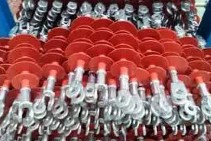
From the product appearance, it is possible to identify differences in manufacturing process and material cost. For example, the sealing quality between the end fittings and the FRP rod, and the high-temperature vulcanized (HTV) silicone rubber housing, can enhance the hydrophobicity of the insulator.
