


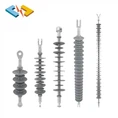


With the development of electrified railway towards the direction of high speed, stability and safety, higher and higher requirements are put forward for the operation of railway overhead contact line. However, due to serious environmental pollution, insulator flashover occurs frequently, resulting in abnormal power supply system. Therefore, it is imperative to ensure the continuous and stable power supply of traction power supply system and eliminate insulator flashover phenomenon.
1. Cause analysis of insulator flashing
Flashover mainly includes pollution flashover, fog flashover and icing, including rain, dew, frost, fog, wind and other climatic effects, or dust, waste gas, natural salt, dust, guano and other pollutants, as well as dust, waste gas, natural salt, dust, guano and other pollution. The process of insulator contamination is usually gradual, but it can also be rapid.
1.1 Pollution flash
Ordinary insulators attached to insulators do not conduct electricity under dry conditions and the insulators will be washed away. However, in areas with serious environmental pollution, near the source of pollution, chemical raw materials in the air and chemicals diffused near the factory, such as carbon powder, cement powder, acid, alkalinity and gold properties, will adhere to the insulator for a long time to form caking. Strong adhesion, not easy to be cleaned by rain, residual surface, in the case of drizzle, fog, dew and other weather, the insulator surface attached to this part of the dirt will be wet, electrical conductivity is greatly improved, resulting in the increase of leakage current. When the leakage current's electric field is strong enough to cause collision ionization of the surface air, corona discharge or glow discharge immediately begins around the iron cap, resulting in a thin blue-purple line due to the large leakage current at this time. Corona or glow discharge can be easily converted into a bright channel arc. In fog and dew weather, the humidity of dirt layer increases, the leakage current increases, and the local length can be maintained under certain electrical conditions. Once the local arc reaches a certain critical length and the temperature of the arc channel is very high, the further extension of the arc channel no longer requires higher voltage and automatically extends through the two stages, resulting in insulator discharge and flashover.
1.2 Fog (wet) flash cause analysis
In a long period of foggy (wet) weather, a layer of water gradually forms on the surface of the ceramic insulator. Due to the loss of hydrophobic property and uneven distribution of field strength of composite insulators, water film will also be formed on the surface of composite insulators. At the same time, the insulator surface is covered with impurities, and the fog water composition is complex. The insulator ends first form corona and partial arc discharge. Due to the increase of air humidity, the field strength of air breakdown will be significantly reduced. Due to the breakdown of the arc between the porcelain skirts at the ends of the insulators, once the first skirt is destroyed, the second skirt will produce a higher voltage, repeating the process just now, because the arc will be extinguished when the AC voltage exceeds zero, so in this case the arc will be extinguished when the AC voltage exceeds zero. The generation of insulator flashover depends on the development of arc and the flow of ionized air. If the fog (humidity) is relatively stable and the arc reignites, it may flash quickly, whereas if the air flow is faster, the ionization channel will disappear quickly and not develop into a flashover.
1.3 Cause analysis of icing flash
It is mainly determined by meteorological conditions, is a comprehensive physical phenomenon determined by temperature, humidity, cold and warm air convection, environment and wind speed and other factors. Small supercooled water droplets are difficult to change structure because of their small diameter and large surface tension. It is also difficult to meet the dust condensation, although the temperature is below zero degrees Celsius, but still at the rate of decline, slowly falling to the ground, forming a "freezing rain." This supercooled water is very unstable. When a droplet is in contact with a cold object (such as an insulator) on the ground, the impact vibration will cause the deformation of the supercooled droplet, and the surface bending degree of the droplet decreases, and the surface tension decreases accordingly. The condensation effect on the surface of the insulator is similar to that of the nodules. After deformation, the liquid supercooled water drops attach, so that the cooling water drops condense on the surface of the insulator into ribbed or ribbed ice, so that the surface of the insulator is covered on the surface of the insulator in the form of RIM or RIM. Thus, the insulation capacity of insulator is reduced, resulting in insulator flashover.
2. Discussion on flashover rule
2.1 Cumulative factors of pollution
(1) Type of insulator. For insulators, the larger the average diameter, the greater the capacity to accumulate pollution. Under the same pollution conditions, catenary insulators with inclined installation are more suitable for accumulating pollution than horizontal insulators due to their structural characteristics and dust removal area, so flashover is more likely to occur. The upper surface of the same insulator is more prone to fouling than other insulators, and the upper surface is easy to flashover.
(2) The influence of pollution sources
In the vicinity of power line equipment, there are yards, cement plants, power plants and coking plants, which can accumulate pollution on the insulator surface and easily cause flashover. The more dense railway freight is, it is also easy to cause insulator flashover one of the main reasons. The main reason is that when the train runs at a speed of 60~100 km/h, dust will fly in the load, and metal dust caused by wheel and rail friction will also splash on the insulator. When the pollution is serious, insulator flashover will be caused. The study also found that bridge floor insulators are in the range of river evaporation for a long time, the relative humidity of insulators is high, and the water repellency of insulators declines year by year. Over a long period of time, a film of water forms on the insulator's surface.
2.2 Seasonal Factors
(1) Weather influence
Precipitation has obvious effect on insulator fouling. In Shandong, insulator pollution accumulation decreased in summer and autumn (July, August and September), and reached the maximum in late winter (January, February and March). Due to high humidity and frequent rain and snow in coastal areas, insulator fog flashover and ice flashover are also likely to occur on March 1 and 2.
(2) The influence of temperature and environment
The peak of flashover occurs in the early morning, so the best time for fog formation and the maximum snowfall are also the lowest time for insulator surface insulation, and the probability of flashover is high. In general, when the sun appears, the inversion layer disappears, the fog slowly dissipates, and flashover may be reduced.
3. Prevention and control measures
3.1 Classification of contaminated areas of different degrees
In order to prevent insulator flashover and power failure, it is necessary to strengthen the anti-pollution work of insulator. First of all, it is necessary to master the characteristics of pollutants and pollution cycle, correctly divide the pollution area, to provide a reliable basis for anti-flashover work. According to different pollution and pollution degree, develop different cleaning methods and cleaning cycles.
3.2 Clean insulators regularly according to seasonal regulations
Strengthening insulation cleaning is the main means to prevent insulation flashover. However, due to the large number of insulators and the heavy cleaning task, dynamic management was carried out on the contaminated area, regular investigation was carried out, and the pollution section was timely adjusted according to the actual situation. They are listed in the ledger according to the current contaminated area standards and are primarily examined for current status and changes in the contaminated area. According to the law of insulator pollution accumulation, a scientific cleaning cycle is established to avoid blind maintenance. In order to obtain the best cleaning effect, the cleaning time of key parts should be arranged before the high frequency flashover. Severely polluted areas will be cleaned up at any time according to the pollution situation. In addition, when cleaning insulator water during the winter and spring melt seasons, cleaning the contamination on the insulator surface is very effective and can effectively reduce the accumulation of pollution on the insulator.
3.3 Replace composite insulators
Composite insulators have good insulation effect and strong antifouling ability. First, it has a strong aversion to swimming. Composite insulator climbing skirt has strong hydrophobicity. Due to the characteristics of silicone rubber material, water droplets form on the surface of composite insulators, making the fouling layer difficult to wet. Thus, the surface condition of the composite insulating medium is improved, so that the fouling layer is not easy to form a continuous conductive layer. The surface leakage current of ceramic insulator is small, which improves the flashover property of insulator. Second, it has self-cleaning function. Composite insulator climbing skirt can play a covering role and reduce insulator dirt. Umbrella skirt itself has a certain slope and smooth surface, which is a soft elastic material. Under the action of wind, rain has strong self-cleaning ability, and umbrella skirt itself has a certain slope and smooth surface. Therefore, the pollution accumulation and salt concentration of composite insulators are significantly reduced, which plays an anti-pollution role. Therefore, composite insulators are suitable for heavy pollution areas or wet coastal areas.
However, the data show that composite insulators are used in some fields due to their excellent hydrophobicity and hydrophobicity migration, but the radial stress of composite insulators (perpendicular to the center line) is very small because they have excellent water repellency and hydrophobic migration properties, while composite insulators are used in some fields due to their good hydrophobicity and hydrophobic migration. The mechanical property is weak. At the same time, due to its own material, the phenomenon of insulator surface flashover is not obvious, so once the composite insulator flashover or internal damage, fault detection is not easy to observe, and equipment recovery is difficult.