


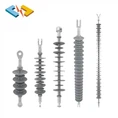

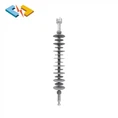

Composite insulator pollution flashover resistance capability is strong, mainly because of its unique hydrophobic and hydrophobic mobility, many scholars at home and abroad in the research of the composite insulator hydrophobic and migration of hydrophobic properties, especially its hydrophobic transference, contrast there are a lot of interpretation, international small molecules widely supported migration theory, it argues that: the surface of the insulator pollution flashover, Small molecules without intersecting chains with other molecules diffuse from the interior of the insulating material to the insulating surface;
Or the small molecules that split from the large molecules migrate to the dirty surface and wrap the dirty surface, which has hydrophobicity; It is also argued that the hydrophobic mobility of synthetic insulators is formed by wrapping the ends and chain segments of macromolecules with filth. In addition, there are many opinions, opinions vary. Therefore, before the development of insulators with better performance, the detection of hydrophobicity of synthetic insulators is of profound significance to ensure the stable operation of the system.
The excellent antifouling and flashover performance of silicone rubber composite insulator comes from the good hydrophobicity and unique hydrophobicity of its outer insulating material silicone rubber. The so-called hydrophobicity refers to that the surface of the insulator is not easy to be affected by moisture, and the absorbed water exists in the form of discontinuous isolated small water beads, which does not form a continuous water film, so as to limit the surface leakage current and improve the flashover voltage. The so-called hydrophobic mobility refers to the dirty surface of silicone rubber, silicone rubber can transfer its hydrophobicity to the dirty surface, so that the dirty surface also has hydrophobicity.
Practice has proved THAT THE hydrophobicity OF composite insulators in operation will decrease or even lose due to pollution, humidity, discharge, low temperature and other factors, which will directly affect the anti-pollution flashover performance of power transmission and transformation equipment and even threaten the safe operation of the system. Therefore, it is necessary to test the hydrophobicity of composite insulators in operation.
There are three common hydrophobicity test methods:
1. Contact Angle method:
This hydrophobicity characterization method is to characterize the hydrophobicity state of composite insulators through the contact Angle formed between the edge of water beads placed on the insulator surface and the material surface.
2. Surface tension method:
This method indirectly reflects the hydrophobicity of composite insulators through the tension on the surface of a given mixed liquid.
3, water spray classification method:
simple operation, this method is through the detection of ordinary spray can spray water spray on the insulator surface, is the first proposed by the Swedish power transmission Research Institute. We can see through observing the wetting state of moisture on the insulator surface and compare the classification criterion and the reference image, so as to get the hydrophobicity state of composite insulator.
At present, in the domestic power companies, power plants and other insulator application scenario, the detection of insulator hydrophobic, the hydraulic classification method used more widely, the use of more hydrophobic detector device for insulator products, when using the product, an operator use insulating rod, rod or under the tower, By manipulating the insulation lever remote control device to be measured quantitatively and spray the surface of the insulator, after the overburden water surface of the insulator, and took these photos will be sent to form a complete set of holding a receiving device, another operator through the analysis of the insulator hydrophobic holding a receiving device built-in software system can automatically analyze the hydrophobic grade insulator under test.