


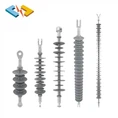


Composite insulators have the advantages of light weight, pollution resistance, easy installation and maintenance, etc. Composite insulators are widely used in the construction of power grids at home and abroad. At present, the number of composite insulators in normal use in China is about 8 million, which is one of the countries with the largest number of composite insulators. Composite insulators are easily affected by many factors during operation, such as machinery, environment and electricity. With the increase of operating time of composite insulators, composite insulators will become hard, brittle and leakage, etc. If composite insulators operate live for a long time, it will affect the normal operation of the power grid. In recent years, the aging problem of composite insulators has attracted the attention of relevant departments.
The external insulating material of composite insulator is mainly high-temperature vulcanized silicone rubber, which is an elastomer obtained by adding various complexes, such as reinforcing filler and structure control agent, to the rubber, and then interacting with vulcanizing agent. High temperature vulcanized silicone rubber has strong stability, hydrophobicity and hydrophobicity recovery. Composite insulator will be in outdoor environment for a long time in operation, and the pollution, corona and moisture in outdoor environment will cause damage to the surface of silicone rubber, which will gradually deteriorate the properties of composite insulator and eventually fail.
At present, the main construction direction of China's power grid is changing to the direction of UHV and UHV. Uhv power grid needs to be built in high altitude and high pollution areas in many cases. Therefore, composite insulators need to face problems such as ultraviolet radiation and corona discharge, which are also the issues that need to be paid attention to in aging of composite insulators.
Aging type and mechanism of composite insulator
The aging of composite insulators can be divided into three types: physical aging, chemical aging and electromechanical aging.
1.Physical Aging
The factors of physical aging of composite insulators mainly include ultraviolet radiation, local high temperature and stress fatigue. Physical aging seriously affects the mechanical and electrical properties of silicone rubber. The exposure experiment of silicone rubber material was carried out during 1998-2005 in China, and the aging of silicone rubber was studied. It was found that when the composite insulator is exposed outdoors for a long time, the photoelectric property of composite insulator will change obviously, among which the change is most obvious in the desert area and subtropical plateau area.
Ultraviolet light has a great accelerating effect on the aging of silicone rubber, although ultraviolet light and can completely cut off the main chain structure of silicone rubber, but ultraviolet light and other factors will combine the oxidation of silicone rubber side chain methyl, eventually leading to the aging of silicone rubber. The main chain structure in silicone rubber will produce free radicals after the break, this part of free radicals of high energy, easy to produce cross-linking reaction between each other. When exposed to the air, free radicals also oxidize with oxygen in the air, producing methane and other gases.
In recent years, with the gradual progress of the West-east power transmission project, a number of high-voltage transmission lines with composite insulators as the main construction materials have been erected in Yunguichuan and Xizang. The natural environment in these areas is more severe than that in other areas, and composite insulators here are prone to aging in application. In Yunguichuan and other high altitude areas, with the extension of ultraviolet irradiation time, the strength and elongation of silicone rubber gradually decreased with the change of time, resistivity will also decrease with the extension of irradiation time, and the hydrophobicity of silicone rubber will show a decreasing trend. The reason for this phenomenon is that the primary bond of composite insulator silicone rubber will be connected under the action of ultraviolet light, which makes the mechanical properties of silicone rubber continuously decline.
The cracking reaction will also produce gas, gas escape from the performance of silicone rubber, silicone rubber surface will appear uneven or even holes. The non-methyl group on the side chain falls off due to oxidation reaction, at this time, the non-methyl group can not form a powerful shield for the main chain, resulting in a gradual decrease in hydrophobicity of the silicone rubber surface. In addition, the hydrophilic groups in the silicone rubber will also absorb water from the surface of the silicone rubber, so that the resistivity of the silicone rubber continues to decline. The break of chemical chain in silicone rubber will also cause the insulation to be weak, leading to leakage and other accidents. Therefore, if a silicone rubber under uv strong environment for a long time, silicone rubber internal will continue to the occurrence of cracking, crosslinking reactions such as oxidation, destroy the molecular structure of the silicone rubber inside, from a macro point of view, to silicone rubber long exposure to ultraviolet light environment fall in silicone rubber electrical performance and mechanical performance is reduced, affect the normal use of silicone rubber.
It is found that the colorant iron oxide can inhibit the thermal oxidation reaction in composite insulator silicone rubber, so as to maintain the stability of silicone rubber, but the use of colorant iron oxide plays a catalytic role in the hydrolysis reaction. When nano silica is added to silicone rubber, the probability of flashover voltage of composite insulator decreases with the increase of added amount. When nano BN particles are added to the silicone rubber, the surface temperature distribution of the silicone rubber will be more uniform, the erosion depth will gradually decrease, the resistance stability of the silicone rubber surface will be enhanced, and the probability of flashover problem will continue to decrease.
Stress fatigue will also accelerate the aging of composite insulators to a large extent. It is found that when high-frequency vibration occurs in the umbrella skirt with load insulators, the vibration will lead to serious stress concentration phenomenon at the root of the umbrella skirt. Under long-term and high-strength load, the root of the umbrella skirt will always be in a state of stress fatigue, which will lead to the generation of micro-cracks. If the micro-cracks are not repaired effectively, the depth of the cracks will continue to increase, and eventually the umbrella skirt will be torn.
2. Chemical Aging
The main causes of composite insulator silicone rubber aging are ozone, acid and base and nitrogen oxide, among which nitrogen oxide reacts with water to produce nitric acid. When the composite insulator is in acidic environment for a long time, the surface of the composite insulator will be seriously corroded. The strong acid will lead to the break of the silicone rubber backbone of the composite insulator, thus causing damage to the silicone rubber material. When the composite insulator is in an alkaline environment, the surface of the composite insulator will show weak alkalinity, and alkaline substances will also cause the primary bond in the silicone rubber to break, resulting in the loss of hydrophobicity of the composite insulator. From the macro point of view, the composite insulator silicone rubber in acidic or alkaline environment for a long time will show the phenomenon of strength reduction.
In the polluted and humid environment for a long time, the hydrophobicity of the silicone rubber surface of composite insulators will gradually weaken, and even disappear completely with the increase of time. When composite insulators are immersed in solutions of different properties, it can be found that the surface of composite insulators in neutral solutions does not change significantly, while the surface of composite insulators in acidic and alkaline solutions shows obvious corrosion phenomenon, and the degree of corrosion is gradually deepened with the increase of acidity and alkalinity. For composite insulators, the acidic environment is more harmful than the alkaline environment.
Due to the discharge phenomenon during the operation of the high-voltage line, the ozone generated by the discharge phenomenon will oxidize and react with the polymer material in the composite insulator. The oxidation reaction will lead to serious defects on the surface of the composite insulator, and even have a serious impact on the performance of the composite insulator.
3. Electrical Aging
In addition to being affected by the natural environment, composite insulators are also affected by high-voltage electric fields, which accelerate the aging of silicone rubber. At the same time, the study of charged composite insulators and non-charged composite insulators shows that the service life of charged composite insulators is far lower than that of non-charged composite insulators, which also indicates that electrical aging is an important factor causing the aging of composite insulators. The composite insulator will be impacted by charged particles in normal operation, which will lead to the break of the composite insulator silicone rubber main chain. At the same time, it will react with the surrounding oxygen and other substances to produce nitrogen oxides and other substances, and then damage the performance of the silicone rubber. Corona arc will also cause high temperature on the surface of composite insulators, which will decrease the electrical and mechanical properties of composite insulators. After the composite insulators are cauterized by corona arc, the content of organic matter on the surface of composite insulators will greatly decrease, resulting in the decline of insulation performance of composite insulators. In all the aging, the reaction process of electrical aging is the most complex, and the electrical aging process will also appear at the same time, physical aging and chemical aging, therefore, the impact of electrical aging on composite insulating materials is the largest.