


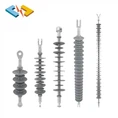

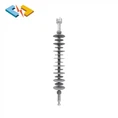
What is a Line Post Insulator?
Composite line post insulator is designed to provide stable support for conductors while also offering resistance to electrical and mechanical stresses. It plays an important role in keeping the conductor in position and ensuring safe and reliable operation of the power system.

This type of line insulator replaces the traditional iron cross-arm. The bottom is connected directly to the pole, while the top is linked to the conductor through a short fitting. With this design, it not only solves the problem of line swing caused by wind but also, thanks to excellent mechanical and electrical performance, ensures safe, reliable, and maintenance-free operation over its full service life.
Where Are Polymer Line Post Insulators Used?
Post insulators can be used in both transmission lines and substations.
In transmission lines, they are called line post insulators.
In substations, they are known as station post insulators or bus post insulators.

Structure of a Post Insulator:
A high-voltage line post insulator typically consists of:
An acid-resistant epoxy fiberglass core rod
HTV silicone rubber weather sheds
Cast steel or forged steel end fittings
|
Item |
Requirement |
Measured Valued |
|
Visual examination |
Fuchsine,grey or white, no obvious mechanical admixture. Vulcanized sillion rubber with dense and smooth cutting surface. |
Ok |
|
Hardness (shore A) |
≮50 |
65~70 |
|
Tensile strength (Map) |
≮4 |
4~6 |
|
Failure elongation (%) |
≮150 |
≮180 |
|
Tearing strength (kN/m) |
≮10 (right angle sample) |
12~15 |
|
Volume resistivity (Ω.m) |
1X10¹² |
3~8X10¹² |
|
Puncture strength (kV/mm) |
Alternating current ≮22 |
≮30 |
|
Tracking and erosion |
TMA4.5,erosion depth≯2.5mm |
TMA4.5, erosion depth <0.8mm |
|
Flammability (Grade) |
FV-0 |
FV-0 |
Manufacturing Process:
The production of line post insulators uses advanced automatic silicone injection molding machines and voice-operated displacement crimping machines. This represents one of the highest levels of process technology in the industry.
Base Types
Rigid curved base
Flexible curved base (also called gain base)
Flat base (steel channel type)
Flange base

Stud base (for ≤69kV insulators)
F-neck type
Tie-top, C-neck, and F-neck designs
Top clamps: clamp top or K-type clamp
Common Clamp Designs
Horizontal line post insulators
Vertical clamp top line post insulators
Two-hole blade (drop tongue) line post insulators
Common Bottom Fittings and Bases
Square flange or round flange
Rigid flat or curved base
Wuhan Line Power normally manufactures the following types of post insulators, covering applications from 10kV up to 500kV transmission and distribution lines.
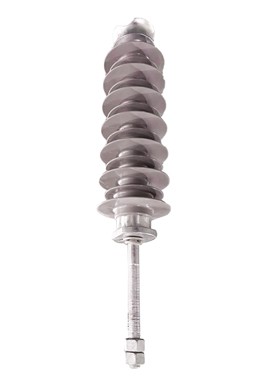
F-neck type

Vertical clamp top line post insulators

Two-hole blade (drop tongue) line post insulators

Flange base

Certificate name