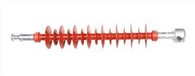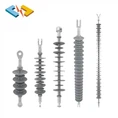

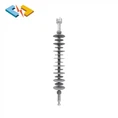

Products Description
A surge arrester is a product installed near the end of any conductor which is long enough before the conductor lands on its intended electrical component. The purpose is to divert damaging lightning-induced transients safely to ground through property changes to its varistor in parallel arrangement to the conductor inside the unit. Also called a surge protection device (SPD) or transient voltage surge suppressor (TVSS), they are only designed to protect against electrical transients resulting from the lightning flash, not a direct lightning termination to the conductors.
Lightning termination to earth results in ground currents which pass over buried conductors and induce a transient that propagates outward towards the ends of the conductor. The same induction happens in overhead and above ground conductors which experience the passing energy of an atmospheric EMP caused by the flash. These devices only protect against induced transients characteristic of a lightning discharge's rapid rise-time and will not protect against electrification caused by a direct termination to the conductor. Transients similar to lightning-induced, such as from a high voltage system's switch faulting, may be safely diverted to ground, however, continuous over currents are not protected by these devices. The energy in the transient is infinitesimally small in comparison to that of a lightning discharge; however it is still of sufficient quantity to cause arcing between different circuit pathways within today's microprocessors.
Without very thick insulation, which is generally cost prohibitive, most conductors running for any length whatsoever, say greater than about 50 feet, will experience lightning-induced transients some time. Because the transient is usually initiated at some point between the two ends of the conductor, most applications install a surge arrestor just before the conductor lands in each device to be protected. Each conductor must be protected, as each will have its own transient induced, and each SPD must provide a pathway to earth to safely divert the transient away from the protected component, be it instrument or computer, etc. The one notable exception where they are not installed at both ends is in high voltage distribution systems. In general, the induced voltage is not sufficient to do damage at the electric generation end of the lines; however, installation at the service entrance to a building is key to protecting downstream products that are not as robust.
knowledge
Several indicators involved in power arresters:
(1) Volt-second characteristics: refers to the corresponding relationship between voltage and time.
(2) Power frequency continuous flow: refers to the power frequency short-circuit grounding current that flows through the lightning arrester when the lightning voltage or overvoltage discharge ends, but the power frequency voltage still acts on the arrester.
(3) Insulation strength self-recovery ability: the relationship between the insulation strength of electrical equipment and time, that is, the speed of recovery to the original insulation strength.
(4) Rated voltage of the arrester: After the power frequency freewheeling current crosses zero for the first time, the maximum power frequency voltage that the gap can bear without causing arc re-ignition is also called arc voltage.
Classification of lightning arresters:
Commonly used arresters include: valve type, tube type, protective gap, metal oxide, etc.
Valve arrester: Valve arrester is mainly divided into two categories: ordinary valve arrester and magnetic blowing valve arrester. Ordinary valve arrester has FS and FZ series. There are two series of magnetic valve type arresters: FCD and FCZ. The meaning of arrester symbols: F-valve arrester, S-distribution (transformation) function, Z-power station, Y-line, D-rotating motor, C-with magnetic blowing discharge gap.
Inspection and maintenance of lightning arresters
Newly installed or overhauled lightning arresters
1. The high-voltage test of a newly installed or overhauled arrester should be qualified, and the following information and data should be obtained from the installation or maintenance personnel, which should not be lower than the standard:
Insulation resistance value;
Conductivity current value;
Main technical parameters.
2. The porcelain and flange are clean and not damaged.
3. Connecting wires, grounding wires and pull wires should be secure.
4. The device body is not tilted, and the pressure equalizing ring is firmly and completely connected.
5. The discharge recording device should be complete and its indicated value should be recorded.
6. For FCD type arresters, the continuity and contact of the parallel resistance should be checked. For 6KV or 15.7KV arresters, the insulation resistance should be measured using a 2500V megger. The resistance should be no less than 150 MΩ. For 220KV arresters, the insulation resistance should be no less than 500 MΩ. And compared with the previous data, there should be no significant change. If it is infinite, it may be that the parallel resistor is broken.
Hot Tags: surge arrester, China, manufacturers, suppliers, factory, wholesale, for sale