


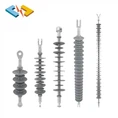

Uhv transmission lines have very unique characteristics. The selected line is eight-split wire, which has a very large space and is also distributed with a very high degree of capacitance, which reduces the losses in the circuit to a large extent. The promotion and application of UHV transmission technology in recent years has greatly solved the problem of unbalanced energy distribution and consumption in China, completed the advantage transformation of resources, fulfilled the growth needs of economic development, improved the carrying capacity of the power grid, and can also play a role in reducing energy consumption of resources.

Uhv transmission lines need to satisfy the requirement of the lines running reliability and sensitivity, also have very good protection effect, if the line fails, the backup device can be implemented in time, to analyze the cause of the failure, so as to take corresponding measures for failure problem to solve, avoid more serious circuit problem.
1. Relay protection requirements for UHV transmission lines
Its basic requirements are as follows:
(1) to have a backup protection system equipment, are generally need to be able to quickly complete the removal of the line fault, as well as with independent running ability to protect the equipment, in which case, are intended to ensure that in the main protection equipment failure to repair or is unable to run, it can realize backup protection work.
(2) The action of the main protection equipment and the arc extinguishing time should be required, and should not exceed the highest value of the overvoltage.
(3) When the line is cut from both ends under the load condition, the time difference generated should not exceed the limited value. The maximum value should be determined by actively calculating the insulator and voltage. Therefore, this is also an important regulation.
(4) In order to limit the overvoltage problem, the start time of automatic reclosing should be specified. If reclosing fails, the peer end on both sides should reduce the voltage.
(5) The resonant overvoltage is calculated through the operation state of the two phases to achieve, if the allowable value is exceeded, then single-phase reclosing can be used in it.
(6) Circuit breaker input/jump should be semi-automatic to ensure that the time difference between input and disconnect at both ends does not exceed the specified value.
(7) In the selection of shunt reactor, the overvoltage caused by the removal fault should be considered. In order to reduce the reactive power loss in the transmission of the reactor, the reactor should be put into use. For the shunt reactor, there should be a switch/switch automatic device, which is started by the line protection.
2.1000kV UHV line relay protection basic requirements
The relay protection of 1000kV UHV line should meet the requirements of reliability, selectivity, sensitivity and quick operation. Compared with UHV and general high voltage line, the relay protection should have greater redundancy and good independence. The relay protection configuration of the 1000kV UHV line can ensure that the protected line can be protected quickly and without delay in the event of a fault in any operating state. The fault at both ends of the line can be quickly removed to prevent electrical equipment damage, system instability or overvoltage and other safety accidents.
On the one hand, the relay protection of 1000kV UHV line should ensure that there is no overvoltage affecting insulators and electrical equipment, and on the other hand, ensure the stability of the 1000kV UHV line. Insulators on 1000kV ultra-high voltage lines cannot withstand large overvoltage, so overvoltage will affect the insulation ability of insulators and even lead to insulation breakdown. In order to ensure that the overvoltage is controlled within the permissible range, the fault removal time of relay protection at both ends of a 1000kV UHV line is much longer than the time when one end is disconnected and the other end is put in.
In order to ensure the stable operation of the UHV line, the fault should be quickly cut off at both ends. It is forbidden to protect one end and disconnect the other end. In order to meet the transmission requirements of the 1000kV UHV line, one is the main protection, and the other is the backup protection that allows tripping signals or transmits tripping signals. The time difference between the two ends of the 1000kV UHV line to cut off faults is controlled within 30-40ms, considering that the time difference between the circuit breaker and relay protection at both ends of the line is 20ms. The main protection Settings should be completely independent from the trip coil to the protection screen, DC power supply, voltage transformer, and current transformer.
3.Special problems of relay protection for 1000kV UHV line
3.1 The capacitor current is faulty
In order to improve the transmission capacity of the 1000kV UHV line, the inductance and resistance of the UHV line should be reduced as much as possible, and the capacitance should be increased to reduce the leakage conductance. Compared with the transmission line of 500kV, the capacitance current, transmission power and impedance Angle of the 1000kV UHV line increase continuously. Influenced by the distributed current capacitors, the phase Angle and amplitude of the current on both sides of the UHV line change greatly, and the differential protection of the line is seriously affected due to the existence of current capacitors. When the load current of 1000kV UHV line decreases, the reliability and sensitivity of differential protection will be reduced, and protection rejection will easily occur after grounding through transition resistance. Therefore, it is necessary to set shunt reactors and adopt effective current capacitor compensation measures to improve the accuracy and reliability of differential protection of UHV line.
3.2 Transient process problems
The transient process of 1000kV UHV line will produce high frequency oscillation component and serious capacitance inductance resonance. When in the transient process, the amplitude and phase of current and voltage of UHV line will be distorted, resulting in a large number of harmonics. When the UHV line resistance is relatively large and the load is small, the ground short circuit is easy to occur, and serious waveform distortion occurs. Because the higher the frequency of the 1000kV UHV line, the greater the equivalent reactance will be, so the equivalent reactance should be reduced as far as possible under the condition of high-frequency component. If a fault occurs at the end of the UHV line, the high-frequency component of the current is large, which mainly includes 11-13 harmonics and 2-4 harmonics. The existence of harmonics will affect the calculation accuracy of the relay protection of the UHV line and easily lead to the steady state exceeding of the relay protection, especially for harmonics close to the fundamental wave. A band-stop filter should be set at a suitable position on the 1000kV UHV line.
4. Transition resistance problem
The transition resistance of the 1000kV UHV line is about 600Ω. Due to the long transmission distance, the zero-sequence voltage will be greatly reduced when the current flows through the end of the 600-ω resistance line. In this case, the voltage of the 1000kV UHV line cannot be combined to correctly determine whether there is a ground fault or the normal operation state. The zero sequence direction protection cannot be accurately judged, resulting in the zero sequence direction protection refusing to operate. In combination with the longitudinal distance and the main protection principle of the vertical direction, the vertical zero sequence main protection is adopted for the ground fault of the 1000kV UHV line, and the relay protection of the line is used to accurately identify the short-circuit problem of the transition resistance of the UHV line.
5. Vertical protection
The uneven distribution capacitance and voltage level of the 1000kV UHV line will affect the longitudinal protection. The synchronous disconnection of the circuit breakers at both ends of the UHV line is only an ideal method. The traveling wave reflected by the power supply on one end of the UHV line may cause overvoltage on the UHV line. The capacitor charging current generated by the distributed capacitor on the 1000kV UHV line will affect the longitudinal differential protection of the line. Therefore, a compensation reactor should be set up on the UHV line to avoid protection misoperation in the normal operation state.