


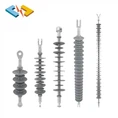

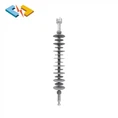

Among the polymer materials that can replace ceramics and glass, silicone rubber has had practical achievements since the 1960s and stands out among several polymers. Silicone rubber insulators have more advantages than ceramic insulators. First, it is light, easy to operate and safe. In addition, ceramic insulators often suffer from breakage, which can be caused by a single impact. And silicone rubber insulators can withstand mechanical shocks, such as when a vehicle hits a telephone pole.
Although other polymer materials also have the advantages described above, but only silicone rubber will not cause too much pollution to the environment. Polymer insulators are waterproof, preventing leakage and surface arcing from falling water droplets. Silicone rubber insulators recover water resistance faster than other polymer insulators, so they are durable materials that can be used in harsh environments for a long time.
1. Characteristics of silicone rubber
1.1 Chemical characteristics of siloxane
1.1.1 Chemically stable bonds
The main chain of silicone rubber is composed of siloxane (Si-O) chains. Since the electronegativity of Si and O on this bond is 1.8 and 3.5, respectively, which are very different, the polarization structure as shown in FIG. 1(omitted) is formed, which has the property of ionic bond. Thus, the bond energy of Si-O is higher than that of C-C (see Table 1). In addition, ① due to the nature of the backbone ionic bond, the ionic properties of the side chain methyl C-H are weakened, which is not easy to be attacked by other molecules, so its chemical stability is good; ② Because Si will not form double bond and triple bond, so it is difficult to form the starting point of backbone decomposition (because of this reason SI-C bond is quite stable), which leads to the backbone of silicone rubber is more stable.
1.1.2 High flexibility polymer
The bond Angle (Si-O-Si) of siloxane is larger (130°-160°), and its degree of freedom is higher than that of organic polymer (C-C, C: 110°). The Si-O bond distance (1.64A) is also larger than that of C-C (1.5A). In other words, the polymer molecules as a whole move easily (easily deform).
Due to the helical structure of polysiloxane, the polysiloxane bond on the main chain is inward due to the ion bond attraction, and the outside is the methyl group with weak side chain interaction, so the intermolecular attraction of polysiloxane becomes small.
1.2 Characteristics of silicone rubber
According to the chemical characteristics described in Section 1.1, silicone rubber has the following characteristics, which can be used in high-voltage insulation situations.
1.2.1 Heat and cold resistance
Because of the high bond energy and chemical stability of silicone rubber, its heat resistance is better than that of organic polymers. Moreover, due to the weak interaction between molecules, the glass transition temperature is low and the cold resistance is good. Therefore, its characteristics will not change when used in any part of the earth.

1.2.2 waterproof
Because the surface of polysiloxane is methyl group, so it is hydrophobic, so it can be used for waterproof.
1.2.3 electrical
The number of carbon atoms in silicone rubber molecules is less than that of organic polymers, so its arc resistance and leakage resistance are very good. In addition, even combustion will also form insulating silicon, so its electrical insulation is excellent. ,
png rod insulator
1.2.4 Weather resistance
Since the bond energy of siloxane is higher than that of ultraviolet light, it is less likely to cause aging due to ultraviolet light. In the ozone resistance accelerated aging test, organic polymer in a few seconds to a few hours will be due to aging and cracking, and silicone rubber even after 4 weeks of aging only slightly decreased strength, and did not produce cracking, that is, its ozone resistance is good. Acid rain is a mixture of ions with a PH of about 5.6, and the solution was used in the artificial acid rain test (500 times). Silicone rubber has excellent resistance to chemicals, although the silicone rubber in acid rain and other mixtures may also have different changes, but I am afraid that the effect is not big.
1.2.5 Permanent deformation
The permanent deformation characteristics (permanent elongation and compressive permanent deformation) of silicone rubber at room temperature/high temperature are better than those of organic polymers.
2 Classification of silicone rubber
According to the characteristics of silicone rubber before vulcanization can be divided into solid and liquid two types, can also be divided into peroxide vulcanization, addition reaction vulcanization and condensation reaction vulcanization three types according to the vulcanization mechanism. The difference between solid and liquid silicone rubber lies in the molecular weight of polysiloxane. Solid silicone rubber can be vulcanized with either of the peroxide vulcanization and addition reactions and is commonly referred to as high temperature vulcanized rubber (HTV) and hot vulcanized rubber (HCR). Although liquid silicone rubber materials vulcanized by addition reaction can also be vulcanized at room temperature, but because of the molding method and vulcanization temperature is different and called liquid silicone rubber (LSR), low temperature vulcanized rubber (LTV) and two-component room temperature vulcanized rubber (RTV), etc. In the manufacture of polymer insulators, injection molding and pouring molding are usually used.
One component condensation reaction type (wet air vulcanized) silicone rubber, can be used for building sealant and electrical and electronic products, useful solvent dilution in power use, room temperature vulcanized silicone rubber coating, by spraying as a protective material for ceramic insulators.
Silicone rubber for polymer insulators
Silicone rubber can be divided into several types according to its use.
3.1 Silicone rubber containing aluminum hydroxide
Silicone rubber with good leakage resistance and arc resistance can be obtained by adding high filling amount of aluminum hydroxide (ATH). Silicone rubber filled with 50 mass of aluminum hydroxide has qualified resistance to high voltage (4.5kV) leakage trace, and has good arc resistance, weather resistance, salt spray resistance and acid rain resistance, can be used as an insulator material in the area of heavy salt spray. However, because this silicone rubber is high filled ATH, so its disadvantages are high viscosity (plastic), low mechanical strength, etc.
3.2 Silicone rubber without aluminum hydroxide
In areas such as inland Europe where there is no salt spray, silicone rubber without ATH can be used because of its low pollution level. On this occasion, by choosing appropriate silicone rubber, white carbon black surface treatment, adding can improve the leakage resistance trace of the compound agent to improve its hydrophobicity, to meet the high voltage leakage resistance trace requirements. Compared with ATH containing silicone rubber, it has lower viscosity, better physical and mechanical properties and electrical properties.
3.3 Outdoor cable accessories
Because it is an outdoor cable accessory, it must have trace resistance to leakage. Materials with low permanent elongation properties can be obtained by using polymers with adjusted cross-linking density for products that shrink at room temperature (cryogenic shrinkage).
3.4 For indoor cable accessories
Because it is a cable fitting for indoor use, it is very unlikely to be affected by salt spray, so it is often not required to have leakage trace resistance. It is still necessary to have low permanent deformation characteristics where shrinkage at room temperature (cryogenic shrinkage) is used.
3.5 Coating Applications
If it is sprayed on the heavily polluted part of the silicone rubber coating, it can maintain good hydrophobicity for a long time. The insulator can also be coated according to the pollution level to achieve the purpose of continued use and cost saving. It has been reported that if silicone rubber insulators are coated, the hydrophobicity of insulators can be further preserved. At present, there are two types of coated insulator and rubber insulator.