


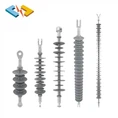

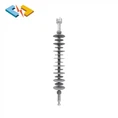
Polymer Suspension Insulator with Line Hardwares
Why are power fittings used with insulators?
1.Fixed clamping: Fittings clamp both ends of the insulator, firmly attaching it to the conductor and tower to prevent slippage and detachment.
2.Load transmission: Bears line tension, wind pressure, and its own weight, smoothly transferring the load to the tower.
3.Electrical connection: Conducts line current, achieving electrical connection between the conductor and the insulator.
4.Shock and vibration protection: Buffers wind vibration and conductor swaying, preventing breakage or damage to the insulator core rod.
5.Sealing and protection: Seals end gaps, providing waterproofing, moisture protection, and protection against internal insulation aging and breakdown.
6. Installation compatibility: Standardized mounting dimensions match standard installation interfaces for towers and conductors.

Suspension Clamp
Suspension clamps (commonly called suspension clamps) for composite insulators are core power fittings used in conjunction with composite insulators in transmission lines. They are mainly used to fix the conductors below the composite insulator strings on straight towers, while bearing the vertical load of the conductors and allowing the conductors to sway with the wind.

Core Functions
Mechanical Suspension: Reliably suspends the conductor on the composite insulator string, bearing the conductor's own weight, icing, wind loads, and other mechanical tensions. The gripping force is typically required to be no less than 12% of the conductor's rated breaking strength.
Electrical Protection: Fixes the conductor's position, reduces wear between the conductor and insulator, lowers the risk of corona discharge, and protects the end fittings of the conductor and composite insulator.
U Shackle
A U-shackle is a type of U-shaped metal connector commonly used in power transmission lines and the lifting industry. You'll often see it on the tower end connections of composite insulator strings.
Structure and Principle
U-shaped body: Forged from high-strength alloy steel, the overall shape is U-shaped, used to fit around two components that need to be connected.
Pin/bolt: Passes through holes at both ends of the U-shape, locking the two components inside to achieve a detachable connection.
Nut + cotter pin: Prevents bolts from loosening, ensuring safe long-term operation.

Core Functions
In the composite insulator strings you encounter, the U shackle acts as an "intermediate connector" between the tower material and the insulator. Its main functions are:
Flexible connection:Connecting the end fittings (such as ball joints) of the insulator string to the attachment points on the tower (such as crossarms or tower arms), while allowing the insulator string to swing at a certain angle to avoid stress concentration.
Tensile load bearing:As a load-bearing component, it must withstand the total tensile force from the insulator string, conductor, icing, and wind loads. Therefore, the model is usually selected based on the rated breaking load (such as 70kN, 100kN), such as U-7 and U-10 (the numbers represent the ton-level breaking load).
Easy installation and maintenance:Using bolts and cotter pins, installation and disassembly are very convenient, facilitating the replacement of insulator strings or adjustment of the line.
Socket-tongue
Socket & Tongue (also commonly referred to as Socket Clevis / Socket Tongue) are paired connecting fittings specifically designed for insulator strings in transmission lines, serving as the core mechanical connectors between composite/pin-type insulators and other hardware fittings.

Core Functions (Power Scenarios)
Fast and Reliable Mechanical Connection:This is the most common connection method for insulator strings. During installation, simply insert the Tongue into the Socket; the internal spring pin automatically locks it in place, requiring no additional tools. It can withstand the entire tensile load of the line (selected according to 70kN/100kN/120kN ratings).
Allows Free Swinging of Insulator Strings: The spherical/conical mating structure allows the insulator string to swing within a certain angle, releasing stress caused by wind deflection and icing, and preventing fatigue fracture of the insulators or fittings.
Standardized Compatibility: Fully compliant with international power standards such as IEC/ANSI/GB, with uniform dimensions. Insulators and fittings from different manufacturers are interchangeable, making it a universal interface for global transmission lines.