


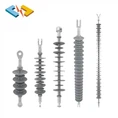

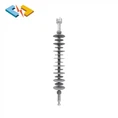


Long Rod Polymeric Tension Insulator
Products Description
composite insulator insulator made of at least two insulating parts, namely a core and a housing equipped with metal fittings.
core of a composite insulator internal insulating part of a composite insulator which is designed to ensure the mechanical characteristics.
housing external insulating part of a composite insulator providing the necessary creepage distance and protecting core from the environment.
shed of an insulator insulating part, projecting from the insulator trunk, intended to increase the creepage distance.
interfaces surface between the different materials.
end fitting integral component or formed part of an insulator intended to connect it to a supporting structure, or to a conductor, or to an item of equipment, or to another insulator.
Our factory & quipment


The Drawing

Dimensions:
Height:1475±40mm
Min .Dry Arcing Distance:1100mm
Min. Creepage Distance:3700mm
Diameter of the rod:φ30mm
Coupling Dimensions: Clevis/ Tongue
Number of sheds:27
Raw materials:
1. End-fitting material: Forged steel or cast steel, hot dip galvanized.
2. Minimum thickness of the galvanization:86μm
3. Core material: Epoxy& Glass Fiber, acid-resistant type.
4. Diameter:φ30mm
5. Weather sheds material: HTV Silicone.
6. Color: Gray
The development of the Polymer Insulator
1.Market Size Continues to Grow
The global market size for silicone rubber composite insulators continues to expand, growing from approximately US$2.3 billion in 2024, and is projected to experience significant growth around 2030.
Multiple market research reports predict a compound annual growth rate (CAGR) of 5%–8% for the overall composite insulator market, with silicone rubber insulators accounting for the majority of this growth.
Increased demand in the high-voltage and ultra-high-voltage transmission line sector will be the main driver of growth, while the medium- and low-voltage sector will grow in tandem with urban power distribution network upgrades.
Conclusion: Steady market growth will drive industry investment and capacity expansion.
2. Technological Innovation Drives Product Performance Upgrades
Continuous advancements in next-generation silicone rubber formulations and polymer materials technology have given insulators stronger hydrophobicity, aging resistance, UV resistance, and anti-flashover capabilities.
Improved manufacturing processes and intelligent production technologies further enhance product consistency, reliability, and lifespan, while reducing manufacturing and on-site maintenance costs.
Future high-end trends include the adoption of advanced technologies such as carbon fiber core rods, nanomaterial modification, and intelligent online monitoring. Conclusion: Technological innovation will further enhance the competitiveness of silicone rubber composite insulators and expand their application capabilities in more demanding environments.
3. Significant Expansion of Application Areas
With the upgrading of power system structures and the advancement of energy transformation, the application space for silicone rubber composite insulators is continuously expanding:
🔹 Transmission Lines and UHV Projects
Large-scale high-voltage and UHV construction increases the demand for high-performance insulators, especially lightweight, pollution-resistant, flashover-resistant, and wind-vibration-resistant composite insulators.
🔹 Renewable Energy Grid Connection
Wind power, solar power, and other new energy projects place higher demands on the reliability of power transmission and distribution systems, promoting the adoption of insulators with excellent electrical performance and environmental adaptability.
🔹 Urban Distribution Network Upgrades and Smart Grids
Distribution automation and intelligent transformation also require more reliable and easier-to-maintain insulator products.
Conclusion: From traditional power transmission to new energy and smart grid applications, the application prospects are broad
Hot Tags
polymer insulator types, polymer insulator advantages, polymer insulator applications, polymer insulator manufacturers,
polymer insulator suppliers, composite insulator for transmission line, polymeric suspension insulator, polymeric tension insulator
insulator creepage distance polymer, non ceramic HV insulator specifications, best polymer insulator for polluted environment,
polymer insulator price, polymer insulator datasheet, how polymer insulator works, polymer insulator installation
Hot Tags: long rod polymeric tension insulator, China, manufacturers, suppliers, factory, wholesale, for sale, 110kV Composite Suspension Insulator, 11kv polymer disc insulator, 400kV Composite Long Rod Insulator, Composite Tension Insulator, Polymer Long Rod Insulator, Polymer suspension insulator


